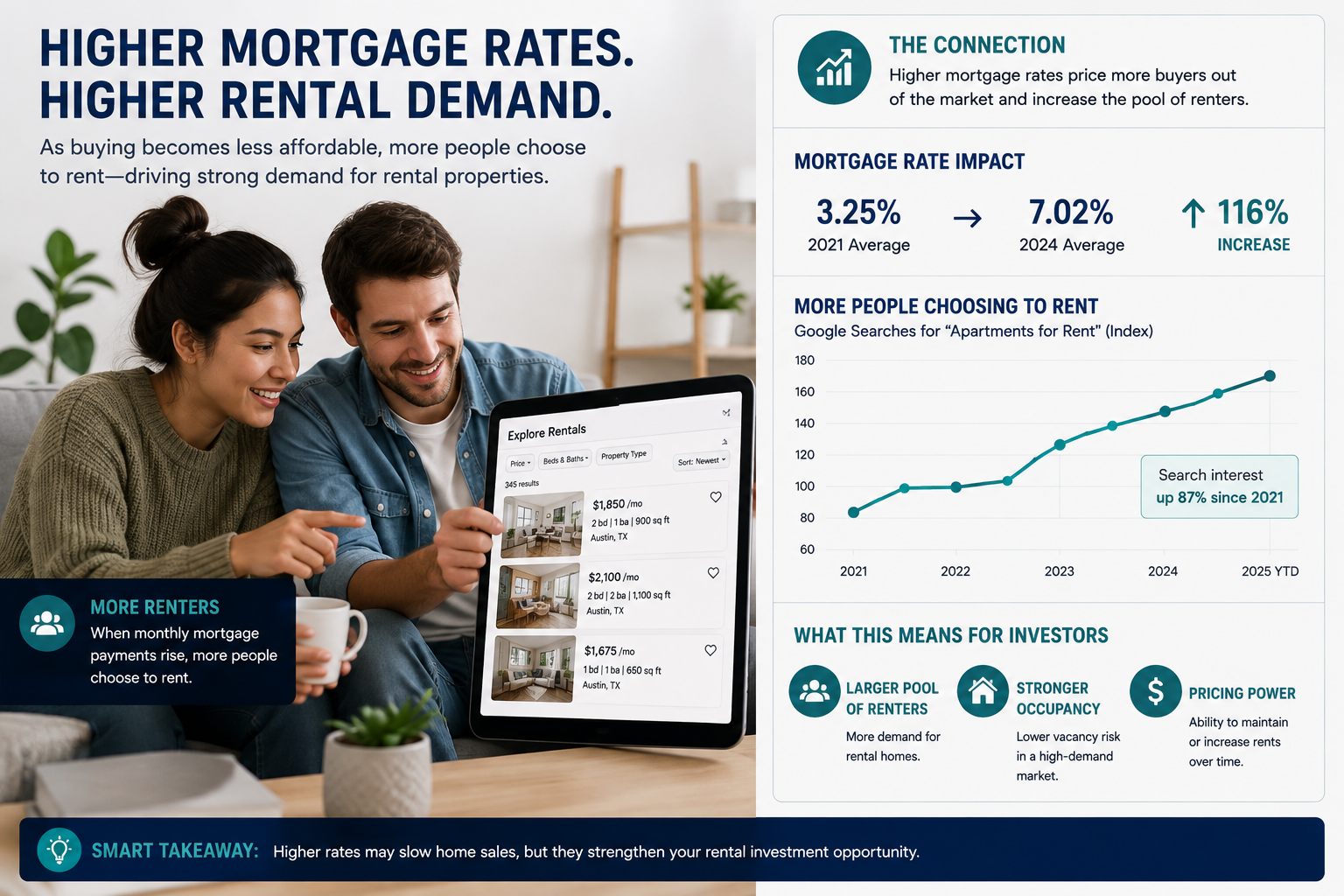
Rising interest rates increase the cost of financing a new rental purchase, with investment property mortgage rates running roughly 7.1% to 7.6% as of mid-2026, about 0.5 to 1.5 points above primary residence rates. They don’t change the mortgage on a property you already own with a fixed rate, and they tend to push more renters into the rental market rather than fewer, which supports demand even as new acquisitions get more expensive.
Every rate headline lands the same way for a landlord: with a jolt of anxiety that doesn’t always match what’s actually changing. Higher rates are a real cost if you’re buying your next property. They’re close to irrelevant if you’re holding a property you already financed at a lower fixed rate. Conflating the two is how a lot of otherwise sound investors talk themselves out of decisions the numbers don’t actually support.
The useful exercise is separating what rate changes affect from what they don’t, because the honest answer is a mix of both, and the mix depends entirely on where you sit, current owner, prospective buyer, or someone weighing whether to sell.
What Actually Changes: The Cost of New Financing
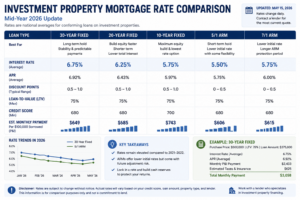
If you’re financing a new purchase, the rate environment is the real story. According to data investment property mortgage rates were running between 7.1% and 7.6%, roughly half a point to a full point and a half above primary residence rates, which themselves moved meaningfully over the year. Analysis shows Freddie Mac’s 30-year fixed rate dropping as low as 5.98% in late February 2026 before climbing back to 6.49% by late June, illustrating just how much rate volatility investors are underwriting against right now, not just a static high number.
That volatility matters for underwriting discipline. A deal that pencils at 6.5% might not pencil at 7.5%, and the gap between those two numbers on a $250,000 loan is real money every single month. This is exactly why the real ROI formula matters more in a higher-rate environment, not less. Assumptions that were generous enough to survive a 5% rate can quietly turn a deal negative at 7%.
What Doesn’t Change: Your Existing Fixed-Rate Mortgage
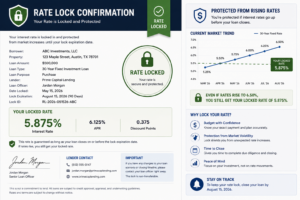
If you already own a rental with a fixed-rate mortgage, rate headlines are largely someone else’s problem. According to research, your largest monthly expense, the mortgage payment, is completely locked in regardless of what the Fed does next. Meanwhile, rents tend to rise with inflation over time, which means your income side of the equation keeps moving even while your biggest cost stays flat.
This is the distinction that gets lost in rate anxiety. A landlord holding three properties financed at 4% two years ago isn’t experiencing the same market as someone shopping for their fourth property today, even though both are reading the same headline.
Rate headlines describe the cost of your next decision. They don’t rewrite the terms of decisions you already made.
The Indirect Effect: What Higher Rates Do to Demand

Higher rates don’t just affect landlords directly, they reshape the market landlords operate in. When mortgage rates rise, fewer prospective buyers qualify for homeownership, or choose to wait it out rather than buy at current rates. That group doesn’t disappear, it becomes rental demand instead. Historically, this dynamic has supported rental pricing power and reduced vacancy risk even during periods when new acquisition costs are climbing for investors.
There’s also a slower-moving effect on property values. Higher rates typically suppress buyer demand for homes, which can compress price appreciation in the near term, sometimes described as a “coil effect” where demand gets delayed rather than eliminated. For a long-term holder, that’s a timing question more than a fundamental one, since the coil tends to release once rates ease.
New Buyer vs. Existing Owner: What the Rate Environment Means for Each
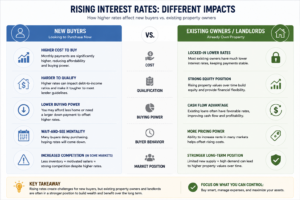
| Factor | New Buyer / Next Purchase | Existing Owner, Fixed-Rate Mortgage |
|---|---|---|
| Financing cost | Directly higher, 7.1-7.6% as of mid-2026 | Unaffected, payment is locked |
| Deal underwriting | Requires tighter margins to still cash flow | Not applicable to existing debt |
| Rental demand | Same tailwind benefits future income | Benefits current occupancy and pricing power |
| Property value | Near-term appreciation may compress | Long-term equity position generally intact |
| Urgency to act | Higher cost makes waiting or negotiating harder terms reasonable | No urgency created by rate news alone |
When Rate Environment Should Change Your Decisions vs. When It Shouldn’t
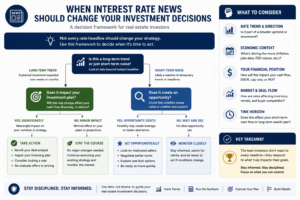
Rate news should influence your decisions when:
- You’re actively underwriting a new purchase and need to stress-test the deal at current, not historical, rates
- You’re deciding between a fixed-rate and adjustable-rate structure on new financing
- You’re weighing whether to refinance an existing property and the math has shifted
Rate news shouldn’t change much when:
- You already hold fixed-rate financing on your current properties
- You’re evaluating whether to sell a property you already own for reasons unrelated to financing costs
- You’re making tenant-facing decisions, screening, maintenance, pricing, none of which are directly tied to your own borrowing costs
Getting Started: Underwriting Correctly in a Higher-Rate Environment

Underwrite new deals at today’s actual rate, not last year’s. A deal that only works with an optimistic rate assumption isn’t a deal, it’s a bet on rates falling.
Separate your existing portfolio’s performance from new-purchase anxiety. Rate headlines shouldn’t make you second-guess properties financed years ago at a lower fixed rate.
Watch rental demand trends, not just rate trends. Higher rates historically push more renters into the market, which can offset some of the acquisition-side pressure for a long-term holder.
Revisit refinance math periodically, not reactively. A refinance only makes sense when the new rate and terms genuinely improve your position, not just because rates moved.
Ready to Stress-Test Your Numbers in Today’s Rate Environment?
If you’re weighing a new purchase against current financing costs, or trying to separate real risk from rate-headline anxiety on your existing portfolio, that’s worth working through with real numbers.
Frequently Asked Questions
How much higher are investment property mortgage rates than primary residence rates?
As of mid-2026, investment property mortgage rates typically run about 0.5 to 1.5 percentage points above primary residence rates, landing in the roughly 7.1% to 7.6% range while primary rates hovered closer to 6.5%.
Do rising interest rates hurt landlords who already own rental properties?
Not directly, if the existing mortgage is a fixed rate. The monthly payment stays locked regardless of rate movement, while rental income tends to rise with inflation over time, which can actually improve cash flow for existing owners even as new acquisition costs climb.
Why do higher interest rates sometimes help the rental market?
Higher rates reduce how many prospective buyers qualify for or choose homeownership, which pushes more of that demand into the rental market instead. This can support occupancy and pricing power for landlords even while it raises the cost of new acquisitions.
Should I wait to buy another rental property until rates come down?
It depends on whether the deal cash flows at current rates. Waiting purely on the hope that rates will fall is a speculative bet, not an investment strategy. A deal that only works at a lower hypothetical rate isn’t a deal worth underwriting today.
Do rising interest rates lower property values?
They can suppress near-term price appreciation by reducing buyer demand, sometimes described as a coil effect where demand is delayed rather than eliminated. This tends to be a timing effect rather than a permanent change in a property’s long-term value.
Is now a good time to refinance a rental property?
It depends entirely on your existing rate and terms compared to what’s currently available. A refinance only makes sense if the new terms genuinely improve your position, lower rate, better cash-out terms, or debt consolidation, not simply because rates have moved since your last mortgage.
How Rentwell Helps Owners Make This Shift
This is the exact shift Rentwell builds for owners across Philadelphia and Pittsburgh: leasing systems that fill vacancies on a predictable schedule, a maintenance program that catches issues before they get expensive, and owner reporting that answers the question before it gets asked. Owners get their hours back, and they get them back with a clearer picture of how each property is actually performing.
If self-managing is starting to feel like a second job instead of an investment, a second set of eyes on the setup costs nothing.
Rentwell is a full-service property management company serving Philadelphia, Pittsburgh, West Chester, and the surrounding Pennsylvania communities. With offices in Clifton Heights, Pittsburgh, and West Chester, Rentwell helps real estate investors protect their assets, reduce operational stress, and build long-term wealth through professional property management.