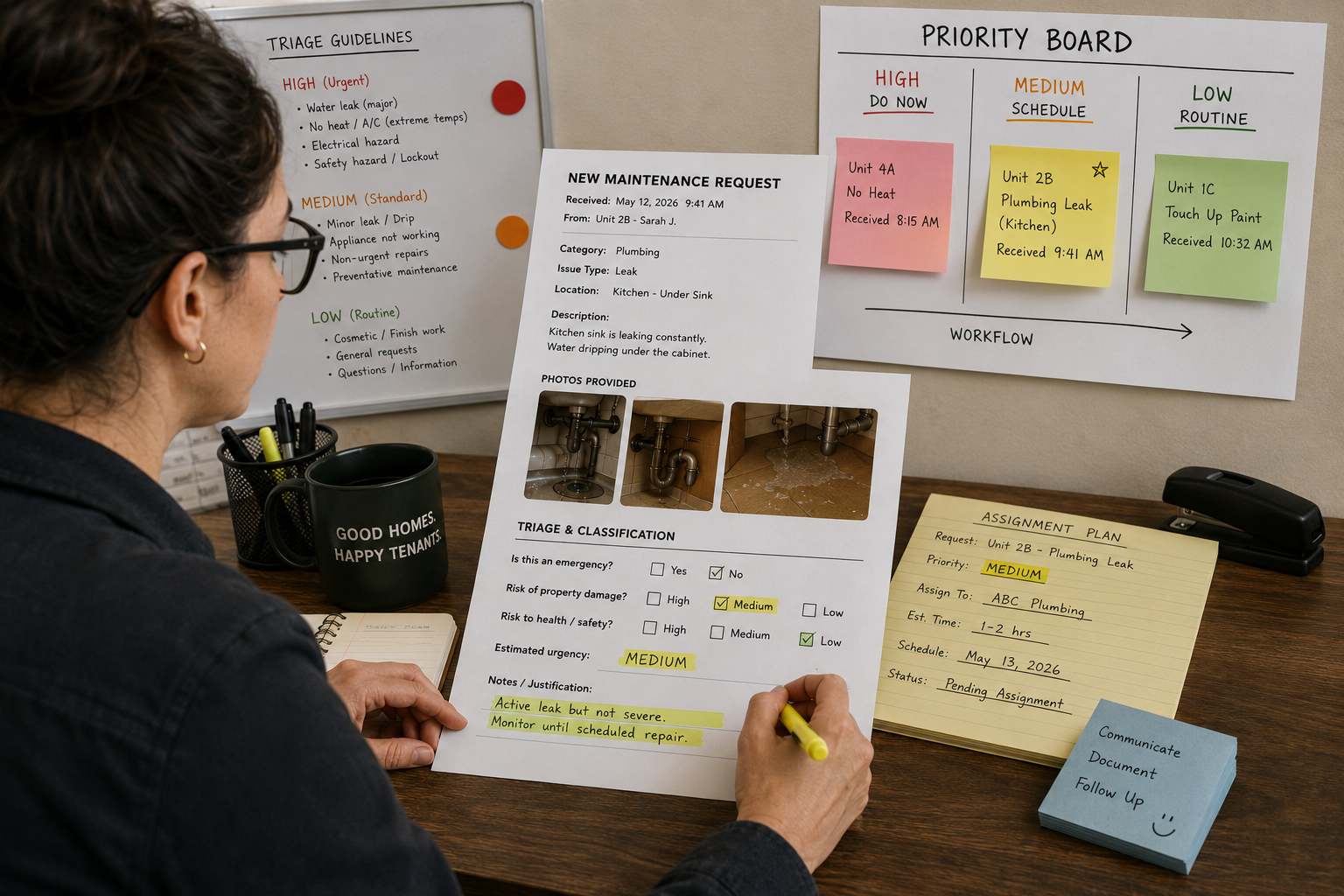
A maintenance issue handled well follows a consistent sequence regardless of the specific repair: the tenant reports it with photos, it gets triaged for urgency within hours, a licensed vendor is dispatched inside the appropriate response window, the owner is notified if it’s above the repair threshold, and the resolution gets documented. The difference between a smooth repair and a chaotic one is almost always whether that sequence was followed, not the repair itself.
Every property, no matter how well maintained, eventually has something break. What separates good management from mediocre management isn’t whether a maintenance issue happens. It’s what happens in the hours and days after a tenant reports it. Walking through what a well-handled issue actually looks like, step by step, makes the difference concrete instead of abstract.
This walkthrough describes a composite, illustrative example built around the process standards covered elsewhere in this content, not a specific address or tenant. The pattern is what matters here, not the particulars of any one property.
Step One: The Report Comes In With Enough Detail to Act On
A tenant notices water pooling under the kitchen sink and submits a request through the maintenance portal, including two photos and a short description: steady drip, worse when the dishwasher runs. That level of detail matters. A vague report, “something’s wrong under the sink,” forces guesswork and often means a vendor arrives without the right parts on hand. A specific report with photos lets whoever’s triaging the issue make an accurate call on urgency before a truck ever gets dispatched.
Step Two: Triage Happens Within Hours, Not Days

The request gets reviewed and classified within a few hours of submission. A steady leak isn’t a true emergency, no active flooding, no safety risk, but it’s also not something that should sit for two weeks. An issue like this falls into the urgent-but-not-emergency tier, generally warranting action within 48 hours rather than the 24-hour window reserved for true emergencies or the multi-day window acceptable for cosmetic requests.
This is also the moment a documented triage system, rather than a judgment call made under pressure, earns its value. Someone reviewing dozens of requests a week needs a consistent standard to sort by, not a fresh decision every time about how urgent “urgent” really is.
The tenant doesn’t experience your triage system directly. They experience how fast their problem gets solved, which is exactly what a good triage system is quietly optimizing for.
Step Three: A Vendor Is Dispatched Inside the Right Window
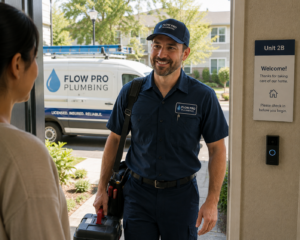
A licensed plumber from an established vendor relationship gets the assignment the same day, with a scheduled visit within the 48-hour window. According to research, this kind of urgent-tier repair should target resolution well inside that window to avoid the kind of tenant frustration that erodes trust even when the underlying issue isn’t dangerous.
The vendor diagnoses a worn supply line connector, not the disposal itself, and completes the fix in under an hour. Because the vendor relationship is established, there’s no back-and-forth negotiating pricing or availability in the moment, the terms and expectations were already set before this specific call ever came in.
Step Four: The Owner Is Notified Appropriately
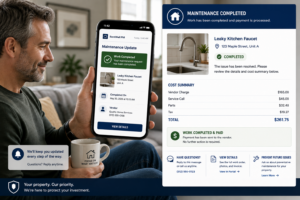
The repair costs $165, comfortably under a typical $300-500 repair approval threshold, so it’s handled without a call to the owner mid-repair. The owner does see it on the next monthly statement, itemized with the vendor name and description, not buried as a vague line item. If the repair had come back higher, say a full disposal replacement pushing past the threshold, the process would have paused for a quick approval call before work proceeded, with a vendor quote in hand rather than an open-ended ask.
This is the repair-threshold system covered elsewhere doing exactly what it’s designed to do: letting routine work move fast while keeping the owner in the loop on anything that actually needs their input.
Step Five: The Resolution Gets Documented

The completed repair gets logged with before-and-after photos, the vendor’s invoice, and a note on the root cause. That documentation isn’t paperwork for its own sake. It’s what lets a pattern get caught later, if the same connector fails again in eight months, that history flags a possible larger plumbing issue worth a closer look rather than another isolated quick fix.
What Made This Repair Go Smoothly
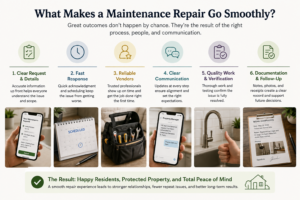
| Step | What Happened | Why It Mattered |
|---|---|---|
| Report | Detailed, with photos | Enabled accurate triage without guesswork |
| Triage | Classified within hours | Set the right urgency tier and response window |
| Dispatch | Established vendor, same-day assignment | No delay negotiating terms mid-crisis |
| Owner notification | Below threshold, handled directly, itemized later | Kept the process fast without leaving the owner uninformed |
| Documentation | Logged with photos and root cause | Enables pattern recognition for future issues |
Nothing about this sequence required luck or an unusually easy repair. It required a system that was built before the leak ever started.
What Happens Without This System
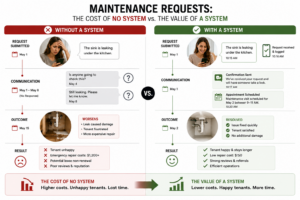
A vague report without a system leads to:
- A vendor showing up without the right information, sometimes without the right parts
- No clear urgency classification, so a genuinely time-sensitive issue can sit as long as a cosmetic one
- An owner discovering the cost after the fact with no context for why it happened
A documented system, even for something small, produces:
- Faster resolution because triage and dispatch don’t require improvised decisions
- Clear owner communication that matches the actual significance of the repair
- A record that makes the next similar issue easier to diagnose
Getting Started: Building This System Into Your Own Process
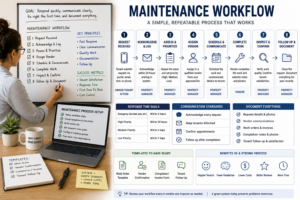
Require photos with every maintenance request. This single habit removes most of the guesswork from triage.
Set your urgency tiers and response windows in writing, before you need them. Deciding under pressure produces worse outcomes than deciding in advance.
Establish vendor relationships before an emergency forces you to find one. Negotiating terms mid-crisis costs more, in time and often in price, than doing it ahead of time.
Document every repair with photos and a root-cause note, even minor ones. This is what turns isolated repairs into a pattern you can actually manage.
Ready to See This System Running on Your Properties?
If your current maintenance process depends on improvising a response every time something breaks, that’s exactly the kind of system professional management is built to run consistently.
Frequently Asked Questions
What makes a maintenance issue get resolved smoothly instead of turning into a headache?
A clear, consistent process: a detailed tenant report with photos, quick triage into the right urgency tier, dispatch to an established vendor within the appropriate response window, owner notification handled according to a pre-set threshold, and documentation of the resolution. The specific repair matters less than whether this sequence is followed.
How quickly should a property manager respond to a non-emergency maintenance request?
Urgent but non-emergency issues, like a steady leak that isn’t actively flooding, typically warrant action within 48 hours. Routine and cosmetic requests can reasonably wait longer, while true emergencies require action within 24 hours or immediately.
Why does documentation matter for routine maintenance repairs?
Documentation, including photos and a root-cause note, lets a property manager or owner spot patterns over time. A single repair might look isolated, but a documented history reveals whether the same issue keeps recurring, which often points to a larger underlying problem worth addressing.
Does every maintenance repair require owner approval?
No. Repairs at or below an agreed repair approval threshold, typically $300 to $500, are usually handled without contacting the owner first, though they’re still itemized on the next financial statement. Repairs above that threshold require approval before work proceeds.
What should a tenant include when submitting a maintenance request?
A clear description of the issue and, ideally, photos. Detailed reports let a property manager triage accurately and often let a vendor arrive prepared with the right parts, which speeds up resolution significantly compared to a vague report.
Why do established vendor relationships matter for maintenance response?
Established vendor relationships mean pricing, availability, and expectations are already set before a specific repair comes in, which removes the delay and cost uncertainty of negotiating terms mid-emergency. This is one of the biggest differentiators between fast, predictable maintenance response and slow, improvised response.
How Rentwell Helps Owners Make This Shift
This is the exact shift Rentwell builds for owners across Philadelphia and Pittsburgh: leasing systems that fill vacancies on a predictable schedule, a maintenance program that catches issues before they get expensive, and owner reporting that answers the question before it gets asked. Owners get their hours back, and they get them back with a clearer picture of how each property is actually performing.
If self-managing is starting to feel like a second job instead of an investment, a second set of eyes on the setup costs nothing.
Rentwell is a full-service property management company serving Philadelphia, Pittsburgh, West Chester, and the surrounding Pennsylvania communities. With offices in Clifton Heights, Pittsburgh, and West Chester, Rentwell helps real estate investors protect their assets, reduce operational stress, and build long-term wealth through professional property management.