Maintenance gets expensive mainly through deferral, not through the underlying cost of repairs themselves. A $200 preventive fix delayed for a year can become an $2,000 problem, and delayed two years, $8,000 or more, as small issues compound into larger ones. Reactive repairs alone typically cost 30 to 50% more than the same work done on a planned schedule, before factoring in any secondary damage the delay caused.
Every owner has had the moment of looking at a repair bill and wondering how a problem that started so small got so expensive. The honest answer is almost never “repairs are just expensive.” It’s that the repair wasn’t actually as small as it looked when it was first noticed, and the gap between noticing and fixing is where most of the real cost gets added.
Understanding exactly how that escalation works, and where it compounds fastest, turns “maintenance is expensive” from a resigned complaint into something you can actually manage down.
The Escalation Math, Made Concrete
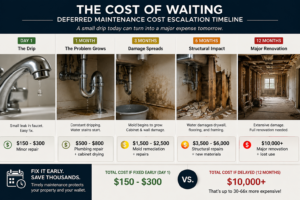
The escalation pattern is remarkably consistent across property types: costs compound at roughly 3 to 4 times the original prevention cost with every 6 to 12 months of continued deferral. A $500 task deferred for a year can become $2,000. Deferred for two years, $8,000 or more.
The mechanism is straightforward once you see it laid out. A $200 plumbing inspection deferred to save budget this quarter turns into a slow leak inside a wall, invisible until water damage shows up on the ceiling below. By the time it’s addressed, the repair has escalated from a $200 inspection and preventive seal to emergency water damage remediation, ceiling replacement, drywall restoration, and potentially mold remediation, easily $5,000 to $8,000. The original problem didn’t get more expensive to fix. A much bigger, different problem grew inside the delay.
Reactive Repairs Cost More Even Without a Catastrophic Failure
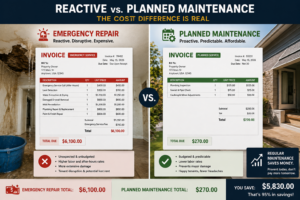
Not every deferred repair ends in a dramatic failure, but even the ones that don’t tend to cost more than they would have on a planned schedule. Reactive work across a portfolio typically costs 30 to 50% more than the same work completed on time, driven by after-hours service premiums, expedited parts, and emergency vendor availability rather than any single catastrophic event.
That baseline premium applies even to routine repairs handled reactively rather than proactively. A vendor called for an emergency same-day fix charges differently than one scheduled two weeks out during a routine maintenance window, regardless of whether the underlying repair itself was complicated.
The repair rarely gets more expensive because the problem changed. It gets more expensive because the deadline changed, from planned to emergency, and emergencies always cost more.
Why This Is Getting Worse, Not Staying Flat
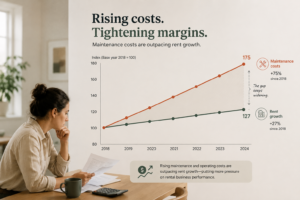
According to research, repair and service costs are currently rising faster than general inflation, and in many markets, faster than rent growth itself. Aging housing stock compounds this further, plumbing, roofing, and electrical systems with finite lifespans are reaching the end of that lifespan across a large share of existing rental inventory, including much of the housing stock common throughout Philadelphia and Pittsburgh.
That combination, rising per-repair costs and aging systems needing more attention, means deferral is a worse bet today than it was even a few years ago. The math that might have marginally worked in a lower-inflation environment doesn’t hold up as well now.
What Actually Reduces Maintenance Costs Over Time

Address small issues immediately rather than waiting for a “better time” to deal with them. The delay itself, not the repair, is what generates most of the added cost. A dripping faucet, a slightly aging roof, or an HVAC system that still technically works are exactly the kind of issues that feel safe to postpone and quietly aren’t.
Follow a scheduled preventive maintenance calendar rather than waiting for tenant complaints to drive repair timing. Routine inspections catch worn-out roofing or minor plumbing leaks while they’re still cheap to fix, rather than after they’ve become visible as ceiling stains or spiked water bills.
Track repair history to spot patterns early. A system that’s needed two or three service calls in a short period is telling you something a single isolated repair record can’t, usually that a full replacement, planned on your terms rather than forced by a failure, is the more cost-effective move.
Deferred vs. Addressed: The Real Cost Difference
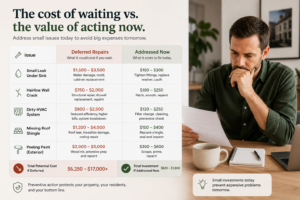
| Timing | Approximate Cost Multiplier | What Drives the Difference |
| Addressed immediately, planned | 1x baseline | Standard vendor rates, no secondary damage |
| Deferred 6-12 months | 3-4x baseline | Issue compounds, may cause secondary damage |
| Deferred 1-2 years | Up to 8x+ baseline | Secondary damage spreads, larger scope of work required |
| Reactive, emergency response | Additional 30-50% on top | After-hours premiums, expedited parts, emergency vendor rates |
When Deferral Is Genuinely Reasonable vs. When It’s Costing You
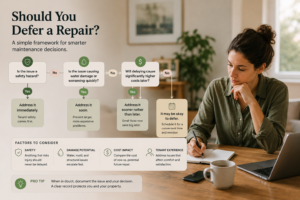
It’s reasonable to schedule rather than immediately act when:
- The issue is purely cosmetic with no risk of worsening or causing secondary damage
- A vendor visit is already scheduled soon for another reason and the issue can be batched in
- The item is genuinely minor and stable, not showing any sign of progression
Deferral is quietly costing you when:
- The issue involves water, electrical systems, or anything with a realistic path to secondary damage
- You’re postponing specifically to avoid the cost this quarter, not because the issue is actually stable
- A similar issue has already recurred once, suggesting the underlying system is nearing failure
Getting Started: Building Cost Discipline Into Your Maintenance Process

Treat small issues as time-sensitive, not optional. The instinct to wait for “a better time” is exactly what triggers the escalation math described above.
Keep a preventive maintenance calendar and actually follow it. Scheduled inspections catch the cheap version of a problem before it becomes the expensive version.
Track repair history per property, not just per repair. A pattern of recurring issues on the same system is a signal worth acting on, not a string of coincidences.
Budget for maintenance inflation, not last year’s numbers. Repair costs are currently rising faster than typical inflation, and planning around outdated cost assumptions leads to underfunded reserves.
Ready to Get Ahead of Maintenance Costs Instead of Reacting to Them?
If deferred maintenance has been quietly inflating your repair bills, a preventive system built to catch issues early is worth putting in place before the next small problem becomes a big one.
Frequently Asked Questions
Why does deferred maintenance cost so much more than fixing something right away?
Deferred issues compound over time, often causing secondary damage that expands the scope of the eventual repair. Costs typically escalate 3 to 4 times the original prevention cost with every 6 to 12 months of continued deferral, and reactive emergency repairs add an additional 30 to 50% on top from after-hours premiums and expedited service.
Is rental property maintenance actually getting more expensive, or does it just feel that way?
It’s actually rising. Repair and service costs are currently increasing faster than general inflation in many markets, and in some cases faster than rent growth, driven partly by aging housing stock reaching the end of its system lifespans.
What’s the fastest way to reduce maintenance costs on a rental property?
Address small issues immediately rather than deferring them, and follow a scheduled preventive maintenance calendar rather than waiting for tenant complaints to drive repair timing. These two habits address the majority of unnecessary cost escalation.
Should I always fix a small maintenance issue right away, even if it seems minor?
For anything involving water, electrical systems, or a realistic path to secondary damage, yes. Purely cosmetic issues with no risk of worsening can reasonably be scheduled rather than addressed immediately.
How can I tell if a recurring repair means a bigger replacement is needed?
Track repair history per property and per system. If the same system has required two or three service calls in a relatively short period, that pattern usually signals the system is nearing the end of its useful life and a planned replacement will likely cost less than continuing to patch it reactively.
Does hiring a property manager actually reduce maintenance costs?
It can, primarily through preventive scheduling discipline, established vendor relationships with better pricing than emergency rates, and consistent tracking that catches patterns an individual owner might miss. The savings come from avoiding the deferred-maintenance cost spiral, not from repairs themselves being inherently cheaper.
How Rentwell Helps Owners Make This Shift
This is the exact shift Rentwell builds for owners across Philadelphia and Pittsburgh: leasing systems that fill vacancies on a predictable schedule, a maintenance program that catches issues before they get expensive, and owner reporting that answers the question before it gets asked. Owners get their hours back, and they get them back with a clearer picture of how each property is actually performing.
If self-managing is starting to feel like a second job instead of an investment, a second set of eyes on the setup costs nothing.
Rentwell is a full-service property management company serving Philadelphia, Pittsburgh, West Chester, and the surrounding Pennsylvania communities. With offices in Clifton Heights, Pittsburgh, and West Chester, Rentwell helps real estate investors protect their assets, reduce operational stress, and build long-term wealth through professional property management.