A landlord mindset focuses on the property, the unit, the tenant, the next repair. An asset owner mindset focuses on the investment, cash flow, risk-adjusted return, and how one property fits a broader financial plan. The shift isn’t semantic. It changes which decisions get made, how problems get evaluated, and whether a portfolio ends up serving its owner’s life or consuming it.
“Landlord” and “asset owner” often describe the exact same person holding the exact same property. What differs is the frame they’re using to make decisions. A landlord asks: is the rent paid, is the unit in good shape, is the tenant happy. An asset owner asks those same questions, but nests them inside a bigger one: is this specific property still the best use of this capital, given everything else I could be doing with it.
That reframe sounds abstract until you watch it change an actual decision. The same $8,000 roof repair looks different through each lens, one person, and one number.
The Landlord Lens: Property-Level Thinking

Landlord-lens thinking is property-centric almost by default, because it’s the natural frame when you’re managing day to day. A repair is a repair. A vacancy is a problem to solve. A tenant complaint is something to fix. None of this is wrong, it’s necessary, hands-on work has to happen regardless of what frame you’re using to think about the bigger picture.
The limitation shows up over time. Property-level thinking tends to evaluate every decision in isolation, is this specific $8,000 roof worth fixing on this specific house, without stepping back to ask whether that capital, deployed differently, might serve the broader goal better. It’s not a bad way to run day-to-day operations. It’s an incomplete way to run a portfolio.
The Asset Owner Lens: Portfolio-Level Thinking

Asset-owner thinking asks a different first question: what is this specific property’s job within my broader financial picture, and is it still doing that job well. According to analysis, serious investors run actual formulas, cap rate, cash-on-cash return, comparing deals rather than relying on intuition or market buzz, precisely because that discipline is what separates asset-owner decision-making from reactive, property-by-property management.
Under this lens, the $8,000 roof repair isn’t just “does the roof need fixing.” It’s “does fixing this roof, on this property, still produce the best risk-adjusted return available to this capital, or would that money work harder somewhere else in the portfolio, or even outside real estate entirely.” Sometimes the answer is still fix the roof. But the question got asked, rather than skipped.
A landlord manages what they have. An asset owner keeps asking whether what they have is still the right thing to be managing.
Why This Shift Matters More in the Current Market

According to data, the current environment particularly rewards investors focused on cash flow discipline rather than hoping appreciation alone carries returns. That’s a distinctly asset-owner framing, evaluating a property on what it actually produces rather than a story about what it might someday be worth.
There’s also a specific advantage asset-owner thinking captures that landlord thinking often misses: the value of existing fixed-rate debt in a higher-rate world. A property purchased years ago with a 3% fixed-rate loan looks increasingly attractive as market rates climb, since the debt cost stays locked while market rents and property values tend to rise. A landlord lens might not connect that dot. An asset owner lens treats it as one of the most valuable, quietly compounding assets in the whole portfolio.
Landlord Thinking vs. Asset Owner Thinking, Side by Side
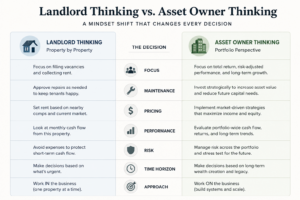
| Situation | Landlord Lens | Asset Owner Lens |
| A major repair comes up | Is the repair necessary for this unit? | Is this property still the best use of this capital? |
| Rent renewal time | What’s a fair increase for this tenant? | Does this rent still reflect market and support the portfolio’s return targets? |
| A property underperforms | This tenant or unit is difficult | Is this specific asset dragging down overall portfolio performance? |
| Considering a sale | Selling feels like giving up | Selling might free capital for a better risk-adjusted opportunity |
| Evaluating debt | The mortgage payment is what it is | This fixed-rate debt is itself a valuable asset in a rising-rate environment |
When Landlord-Level Focus Is Exactly Right vs. When It’s Not Enough

Property-level, landlord thinking is exactly what’s needed when:
- You’re handling day-to-day tenant communication and maintenance decisions
- You’re evaluating whether a specific repair or vendor choice makes sense
- You’re building the operational habits that keep any single property running well
Asset-owner, portfolio-level thinking is needed when:
- You’re deciding whether to buy, sell, or hold a specific property
- You’re evaluating your portfolio’s overall performance, not just individual units
- You’re weighing whether your capital and time would work harder somewhere else
Both lenses matter. The mistake isn’t using landlord thinking, it’s never stepping back to use the other one.
Getting Started: Practicing the Shift

Schedule a portfolio-level review separate from day-to-day management. Even quarterly is enough to force the bigger-picture question that daily operations naturally crowd out.
Run the actual numbers before big decisions, not just intuition. Cap rate, cash-on-cash return, and a clear-eyed look at alternative uses of your capital replace gut feeling with a repeatable process.
Ask “is this still the right asset” before assuming every property should be held indefinitely. Selling isn’t failure. Sometimes it’s the asset-owner decision that a landlord-lens investor would never consider.
Recognize your existing debt as an asset in its own right. A locked-in low rate, held during a period of rising rates, is quietly doing real work in your portfolio even when nothing else about the property has changed.
Ready to Evaluate Your Portfolio at the Asset-Owner Level?
If you’ve been managing your properties one at a time and haven’t stepped back to evaluate the whole portfolio recently, that’s a conversation worth having.
Frequently Asked Questions
What’s the difference between a landlord mindset and an asset owner mindset?
A landlord mindset focuses on property-level decisions: is rent paid, is the unit in good condition, is the tenant satisfied. An asset owner mindset nests those same questions inside a broader one: is this property still the best use of this capital compared to other opportunities within or outside the portfolio.
Why does mindset matter if the day-to-day work is the same either way?
The day-to-day tasks may look similar, but the mindset determines which bigger decisions get made and when. A landlord lens can miss opportunities to sell an underperforming property, refinance strategically, or recognize when a fixed-rate mortgage has become a valuable asset in its own right.
How often should I review my rental portfolio at the asset-owner level?
Many experienced investors do this quarterly, separate from day-to-day property management. This creates dedicated space to ask portfolio-level questions that daily operational tasks don’t naturally prompt.
Does asset-owner thinking mean I should sell an underperforming property?
Not necessarily, but it means asking the question seriously rather than avoiding it out of attachment or inertia. Asset-owner thinking treats selling as one legitimate option among several, evaluated on the numbers rather than ruled out automatically.
Why is a low fixed-rate mortgage considered an asset in a rising-rate environment?
Because the debt cost stays locked while market rents and property values tend to rise with inflation and demand. An asset owner recognizes this as a genuine source of ongoing value, not just a fixed expense to manage.
Can I think like an asset owner even with just one or two rental properties?
Yes. The mindset isn’t about portfolio size, it’s about the habit of periodically stepping back to evaluate whether each property is still the right use of your capital, rather than only ever thinking at the day-to-day, unit-level scale.
How Rentwell Helps Owners Make This Shift
This is the exact shift Rentwell builds for owners across Philadelphia and Pittsburgh: leasing systems that fill vacancies on a predictable schedule, a maintenance program that catches issues before they get expensive, and owner reporting that answers the question before it gets asked. Owners get their hours back, and they get them back with a clearer picture of how each property is actually performing.
If self-managing is starting to feel like a second job instead of an investment, a second set of eyes on the setup costs nothing.
Rentwell is a full-service property management company serving Philadelphia, Pittsburgh, West Chester, and the surrounding Pennsylvania communities. With offices in Clifton Heights, Pittsburgh, and West Chester, Rentwell helps real estate investors protect their assets, reduce operational stress, and build long-term wealth through professional property management.