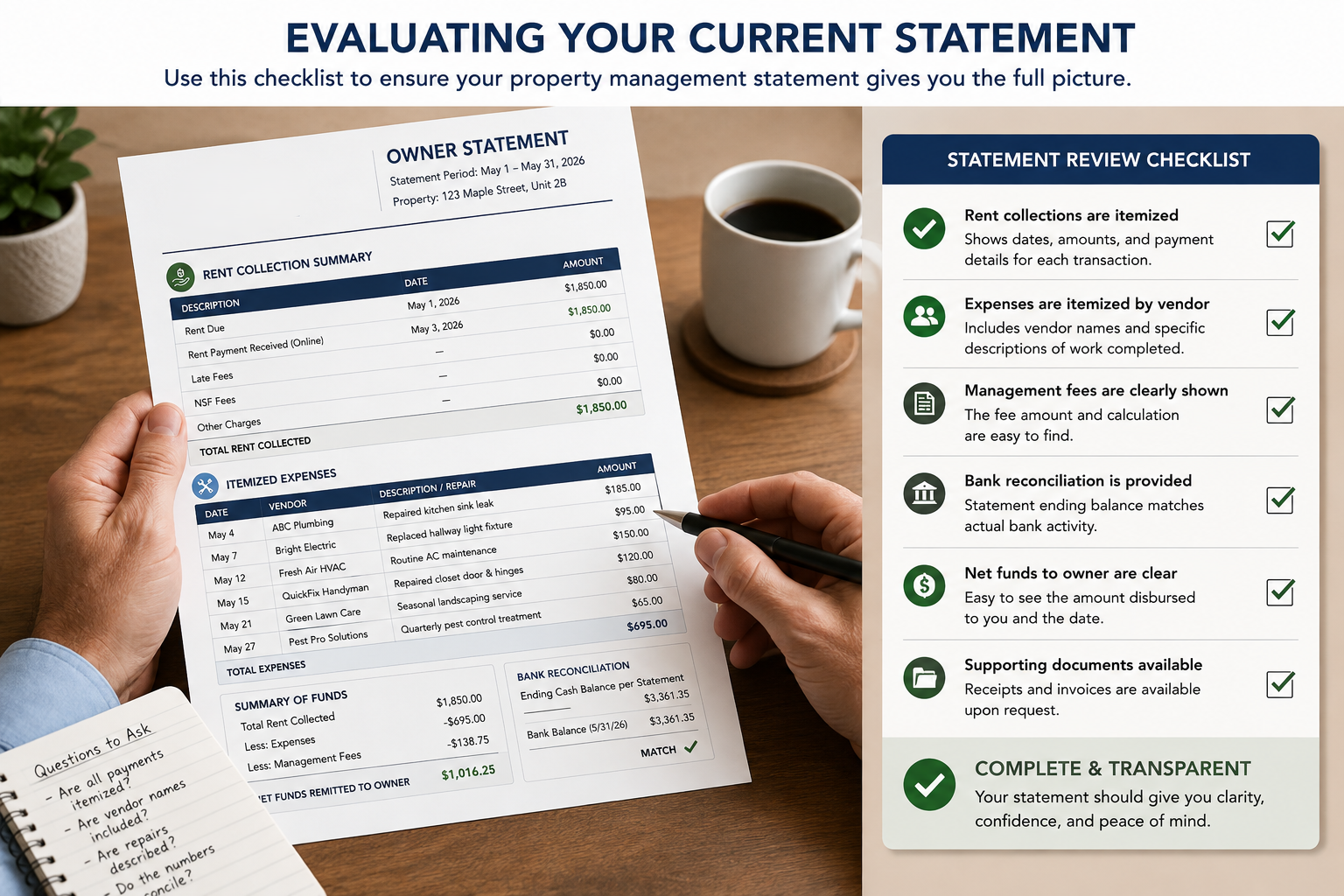
A trustworthy monthly owner statement clearly itemizes rent collected, every expense with a vendor and description, the management fee, net proceeds, and any reserve balance, all reconciled against actual bank activity. If you need a phone call to understand your own numbers, or the report doesn’t match what actually hit your account, that’s a reporting problem worth addressing, not something to just get used to.
A lot of owners quietly accept a confusing monthly statement because they assume that’s just how property management reporting works. It isn’t. A report you can’t parse without a follow-up call isn’t doing its job, and the gap between a genuinely transparent statement and a vague one is usually a matter of a few specific line items, not a fundamentally different level of complexity.
Knowing exactly what should be on that statement gives you a real benchmark, something to check your own reports against rather than just trusting that whatever format you’re getting is standard.
Every Dollar In, Clearly Itemized
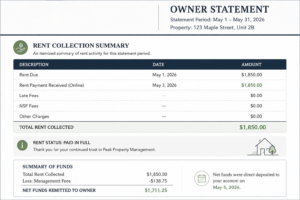
The income side of a statement should show every rent payment received during the period, tied to the correct property and unit, plus any other income, late fees, utility reimbursements, or pet fees. According to research, this section exists to keep owners informed about exactly how funds are being used and distributed, not just a lump total that requires trust without detail.
If a tenant paid late, or a unit sat vacant part of the month, that should be visible here too, not just absent from the total with no explanation. A statement that shows $1,800 collected instead of $1,900 expected, with no note explaining the gap, forces you to guess rather than know.
Every Dollar Out, With a Vendor and a Reason
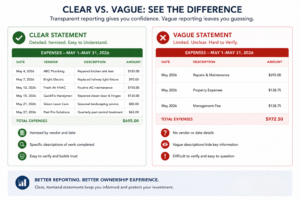
According to research, every expense, maintenance, repairs, management fees, needs to be clearly listed with enough detail to understand what it was and why it was necessary. A line item that just says “repair – $340” tells you less than one that says “kitchen faucet replacement, ABC Plumbing, $340.”
This level of detail isn’t bureaucratic overkill. It’s what lets you spot a pattern, three service calls to the same unit in six months might mean a system needs replacing rather than repeated patching, but you can only see that pattern if the detail is actually there each month.
A vague expense line isn’t more efficient reporting. It’s a report that’s asking you to trust it instead of showing you why you should.
Net Proceeds and Reserve Balances, Not Just a Bottom Line
A complete report includes owner distributions, the funds actually transferred to you, alongside any reserve account balance being held for future repairs or emergencies. Both numbers matter separately. Knowing your distribution tells you what landed in your account. Knowing your reserve balance tells you what’s being held back and why, which protects you from an unpleasant surprise the next time a major repair comes up.
Report structure guidance frames this as the income and expense statement’s core function: breaking down revenue and expenses over the period so the resulting net number isn’t just a total, it’s a total you can trace back to its components.
The Reconciliation Check Most Owners Never Ask About
This is the detail that separates genuinely trustworthy reporting from reporting that just looks organized. A reconciliation summary confirms the numbers on your statement actually match your real bank activity, not just what an internal ledger says should have happened. Without this step, a bookkeeping error can sit undetected for months, quietly under- or over-stating your actual returns.
Asking your property manager directly whether their reporting process includes a reconciliation step is a fair, reasonable question, and a manager confident in their process should be able to answer it without hesitation.
Clear Reporting vs. Vague Reporting: What to Actually Look For
| Statement Element | Clear, Trustworthy Reporting | Vague Reporting |
|---|---|---|
| Rent collected | Itemized by unit, with notes on any shortfall | Single lump total, no explanation |
| Expenses | Vendor name, description, and amount per item | Generic categories with no detail |
| Management fee | Clearly shown as its own line item | Buried or unclear how it was calculated |
| Net proceeds | Traceable back to income minus expenses | A bottom-line number with no visible math |
| Reserve balance | Shown separately, with explanation | Not mentioned at all |
| Reconciliation | Confirmed against actual bank activity | No verification step described |
Getting Started: Evaluating Your Own Reporting
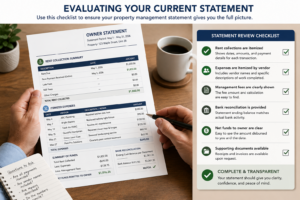
Pull your last statement and check it against the six elements above. Any gap tells you exactly what to ask your property manager to add or clarify.
Ask specifically whether reconciliation is part of the process. This single question reveals more about reporting quality than almost anything else you could ask.
Request a sample statement before signing with any new property manager. A confusing sample is a preview of every month going forward, not an exception.
Don’t accept “call us if you have questions” as a substitute for a clear report. A good statement shouldn’t require a phone call to understand.
Ready to See What Clear Reporting Actually Looks Like?
If your current statements leave you with more questions than answers, that’s worth fixing before it becomes a pattern you’ve just learned to live with.
Frequently Asked Questions
What should be included in a monthly property management owner statement?
A complete statement should itemize all rent collected, every expense with a vendor name and description, the management fee, net proceeds distributed to the owner, and any reserve account balance, all reconciled against actual bank activity.
How do I know if my property manager’s financial reporting is trustworthy?
Check whether expenses are itemized with vendor names and descriptions rather than vague categories, whether the report shows a reserve balance separately from your distribution, and whether the numbers are reconciled against actual bank activity rather than just an internal ledger.
Why does my owner statement show a different number than what hit my bank account?
This can happen for a few reasons: timing differences between when the statement was generated and when funds transferred, deductions for reserves or upcoming expenses, or in some cases a reconciliation error. If the gap isn’t explained on the statement itself, ask your property manager directly.
What is a reserve balance on a property management statement?
A reserve balance is money held back from your distribution to cover future repairs, emergencies, or capital expenses rather than being paid out immediately. It should be shown as its own line item, separate from your net distribution.
How often should I receive a financial report from my property manager?
Monthly reporting is standard for most professionally managed rental properties, giving owners a regular, predictable view of income, expenses, and distributions rather than having to request updates on an ad hoc basis.
What questions should I ask before hiring a property manager about their reporting?
Ask to see a sample statement, ask specifically whether their process includes bank reconciliation, and ask how quickly you’ll be notified of unusual expenses or vacancy periods rather than just seeing them reflected after the fact in a monthly summary.
How Rentwell Helps Owners Make This Shift
This is the exact shift Rentwell builds for owners across Philadelphia and Pittsburgh: leasing systems that fill vacancies on a predictable schedule, a maintenance program that catches issues before they get expensive, and owner reporting that answers the question before it gets asked. Owners get their hours back, and they get them back with a clearer picture of how each property is actually performing.
If self-managing is starting to feel like a second job instead of an investment, a second set of eyes on the setup costs nothing.
Rentwell is a full-service property management company serving Philadelphia, Pittsburgh, West Chester, and the surrounding Pennsylvania communities. With offices in Clifton Heights, Pittsburgh, and West Chester, Rentwell helps real estate investors protect their assets, reduce operational stress, and build long-term wealth through professional property management.