A maintenance emergency is any issue that threatens health, safety, or the structural integrity of the property, like a gas leak, active flooding, no heat in freezing temperatures, or a broken exterior lock. These require a response within 24 hours, often immediately. Non-emergency issues, like a slow drain, a broken dishwasher, or a burnt-out lightbulb, can typically wait for normal business hours and a response window of a few days to a few weeks.
Every landlord has fielded a call that felt urgent to the tenant and turned out to be a lightbulb. Every landlord has also had the opposite experience: something that seemed minor over text turned out to be a slow leak that had already soaked into drywall by the time anyone looked closely. Getting the triage right, quickly and consistently, protects the property, the tenant relationship, and your own sanity at 9 p.m. on a Saturday.
The test that holds up across most jurisdictions and most property managers is simple: would delaying this repair likely cause further damage to the property, or injury to a tenant or neighbor? If yes, it’s an emergency. If the honest answer is no, even if it’s genuinely annoying, it can wait for business hours.
What Actually Counts as an Emergency
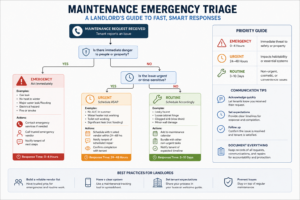
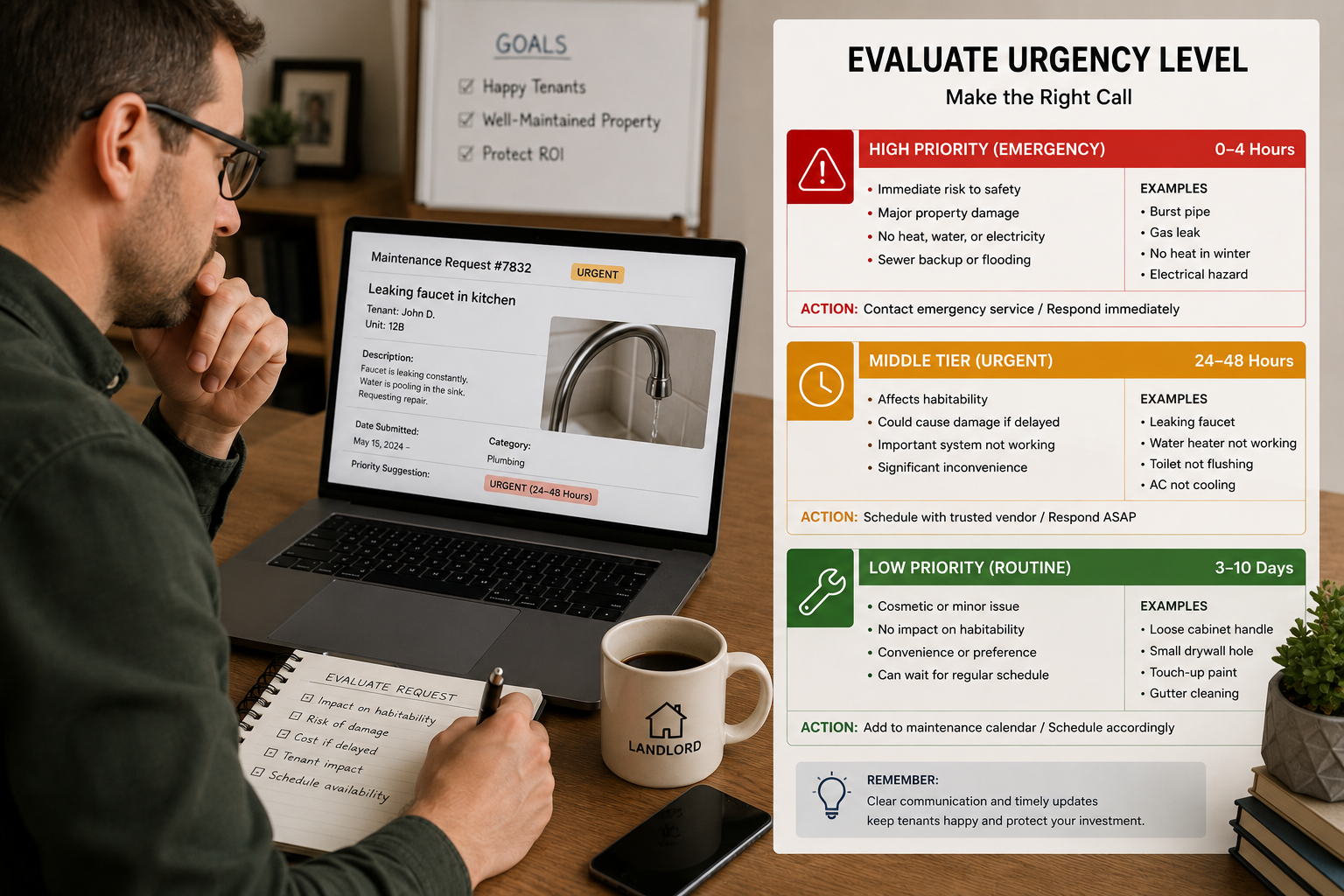
The clearest emergencies share a common thread: active, ongoing risk to safety or the property itself. That includes gas leaks, active flooding or burst pipes, no heat during freezing temperatures, electrical hazards like exposed wiring, and a broken exterior lock or door that compromises security. The standard test is whether the issue could cause injury, serious property damage, or a health and safety threat if it isn’t addressed right away.
Response expectations for genuine emergencies are tight. According to research, most jurisdictions expect a 24 to 48 hour response for true emergencies like no heat or no water, with life-threatening issues, gas leaks, active fire risk, requiring immediate action, not a same-day window.
What Almost Always Waits for Business Hours
A minor appliance not working, a clogged toilet when there are other working toilets in the unit, a burnt-out lightbulb, or cosmetic issues like a scuff on a wall, none of these threaten safety or cause ongoing damage if they wait a few days. Routine repairs should target a one to three day completion window once scheduled, while cosmetic repairs are often best batched into unit turns or quarterly maintenance windows rather than addressed individually as they arise.
The urgent-but-not-emergency middle tier, HVAC failures outside of extreme temperatures, major plumbing issues that aren’t actively flooding, deserves its own faster window. Buildium’s data suggests HVAC issues specifically should be resolved within 48 hours before tenant satisfaction drops significantly, even when the outdoor temperature isn’t dangerous enough to make it a true 24-hour emergency.
The tenant on the other end of the call isn’t wrong to feel like everything is urgent. Your job is to have a system that sorts urgency accurately, not to make them feel like their concern didn’t matter.
The Middle Tier Most Landlords Get Wrong

The category that trips up self-managing landlords most often sits between true emergencies and routine annoyances. A refrigerator that stops cooling isn’t life-threatening, but food spoilage and the cost of a mini-fridge rental while waiting add up fast if it sits for two weeks. A running toilet isn’t flooding, but the water bill impact compounds daily. These issues don’t require a 2 a.m. callout, but they shouldn’t get filed into the same 14 to 30 day bucket as a scuffed wall either.
A useful middle-tier standard: three to seven days for anything that meaningfully affects habitability or daily function without posing an active safety risk. This tier is exactly where having a documented triage system, rather than judgment calls made under pressure, pays off most, because it removes the ambiguity that otherwise leads to either over-responding to minor issues or under-responding to ones that are quietly getting worse.
Response Time by Category

| Category | Examples | Typical Response Window |
|---|---|---|
| True emergency | Gas leak, active flooding, no heat in freezing weather, broken exterior lock | Immediate to 24 hours |
| Urgent, not life-threatening | HVAC failure (moderate weather), major plumbing not actively flooding | 48 hours |
| Meaningful but not urgent | Non-cooling refrigerator, running toilet, minor plumbing leak | 3-7 days |
| Routine | Broken minor appliance, sticking door, single burnt-out fixture | 1-3 days once scheduled |
| Cosmetic | Wall scuffs, minor caulking, non-functional decorative fixture | Batched into turns or quarterly visits |
When to Escalate Immediately vs. When to Schedule
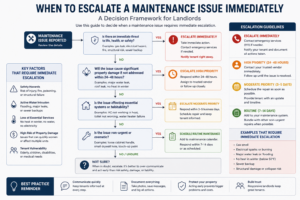
Escalate immediately when:
- There’s any active risk to health or safety, gas smell, exposed wiring, active flooding
- The issue is actively getting worse the longer it sits, like a leak spreading
- A tenant reports being unable to secure the property, a broken lock or door
Schedule during normal hours when:
- The issue is inconvenient but stable, not actively worsening
- A workaround exists in the meantime, a second working toilet, a portable fan
- The tenant’s report is about comfort or cosmetics rather than safety
Getting Started: Building a Triage System That Holds Up
Write your tier definitions down before the first late-night call comes in. Deciding urgency in the moment, under pressure, leads to inconsistent responses.
Give tenants a clear way to report issues with photos. A photo often resolves the emergency-or-not question faster than a phone description alone.
Set explicit response windows for each tier and communicate them to tenants at move-in. Clear expectations reduce the number of “is this urgent” calls in the first place.
Have a real after-hours plan for true emergencies. A voicemail that gets checked Monday morning isn’t a system, it’s a liability waiting to happen.
Ready to Take Maintenance Triage Off Your Plate?
If sorting every maintenance call into the right tier, at every hour, is wearing on you, that’s exactly the kind of system professional maintenance coordination is built to handle.
Frequently Asked Questions
What qualifies as a true maintenance emergency?
A true emergency threatens health, safety, or the structural integrity of the property, including gas leaks, active flooding or burst pipes, no heat during freezing temperatures, electrical hazards, and a broken exterior lock or door. These require a response within 24 hours, often immediately.
How long can a landlord wait to fix a non-emergency issue?
Non-emergency repairs are generally expected within a reasonable timeframe, often 7 to 30 days depending on local law and the specific issue. Routine repairs like broken minor appliances typically target a one to three day completion window once scheduled.
Is a broken air conditioner considered an emergency?
It depends on conditions. During extreme heat that poses a genuine health risk, especially to vulnerable tenants, it can rise to emergency status. In moderate weather, it’s typically treated as urgent but not a true 24-hour emergency, with a target resolution window closer to 48 hours.
What should I do if I’m not sure whether a maintenance request is an emergency?
Ask for photos and specific details, and apply the standard test: would delaying this likely cause further damage to the property or injury to someone? When in doubt, treating it as urgent rather than routine is the safer default.
Can a tenant withhold rent if I don’t fix an emergency quickly enough?
In many jurisdictions, yes. Failing to address a genuine emergency within a reasonable timeframe can expose a landlord to rent withholding, repair-and-deduct claims, or other legal remedies depending on state and local law.
Should I have a different after-hours process for emergencies than for routine requests?
Yes. Genuine emergencies need a real, staffed after-hours response, not a voicemail checked the next business day. Routine and cosmetic requests can be logged and scheduled during normal business hours without a dedicated emergency channel.
How Rentwell Helps Owners Make This Shift
This is the exact shift Rentwell builds for owners across Philadelphia and Pittsburgh: leasing systems that fill vacancies on a predictable schedule, a maintenance program that catches issues before they get expensive, and owner reporting that answers the question before it gets asked. Owners get their hours back, and they get them back with a clearer picture of how each property is actually performing.
If self-managing is starting to feel like a second job instead of an investment, a second set of eyes on the setup costs nothing.
Rentwell is a full-service property management company serving Philadelphia, Pittsburgh, West Chester, and the surrounding Pennsylvania communities. With offices in Clifton Heights, Pittsburgh, and West Chester, Rentwell helps real estate investors protect their assets, reduce operational stress, and build long-term wealth through professional property management.