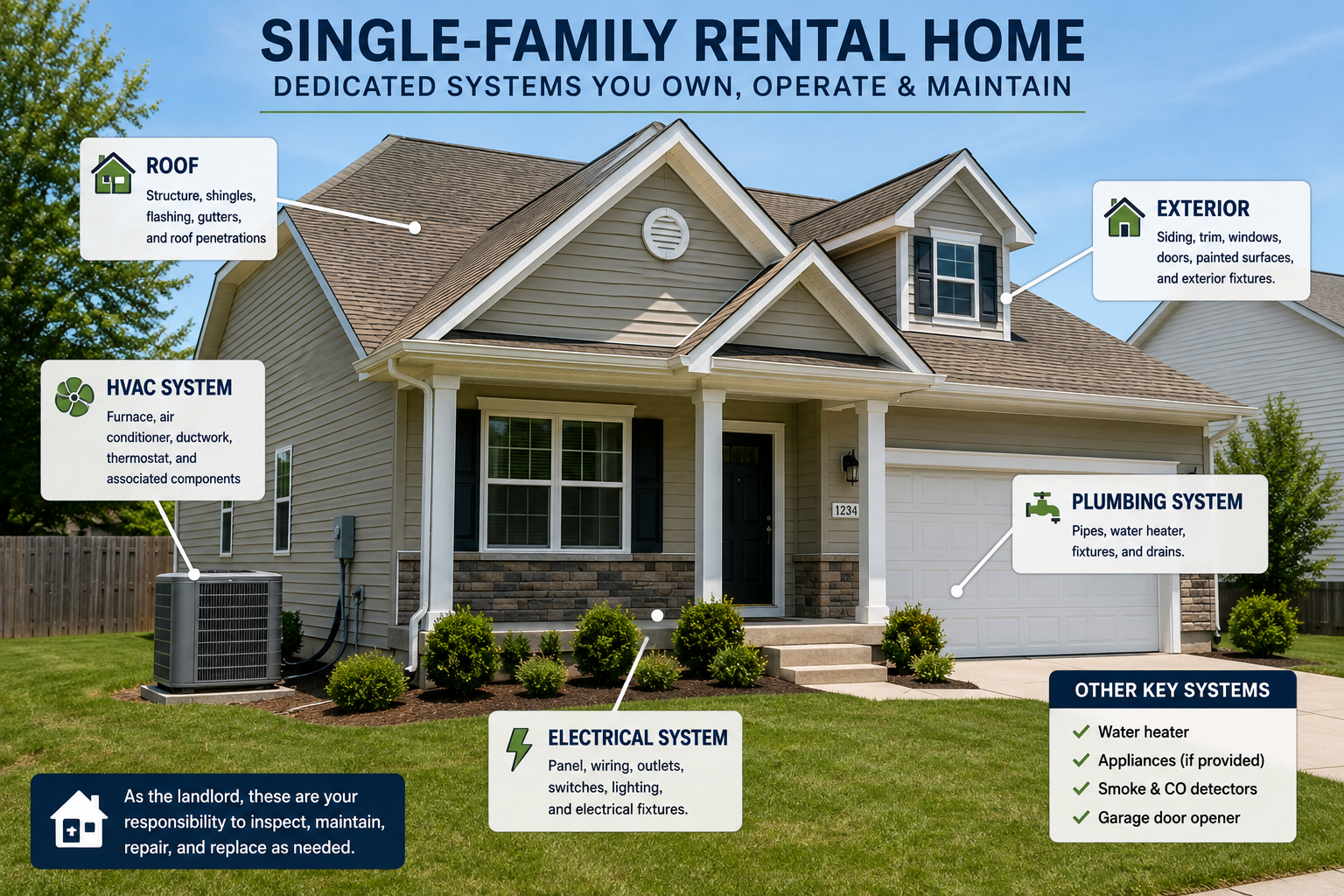
Single-family rentals carry higher per-unit maintenance costs, since every system, roof, HVAC, plumbing, is dedicated to one household, but lower complexity in coordination. Small multifamily properties spread some costs across shared systems and multiple rent rolls, but introduce coordination complexity, common-area maintenance, and the risk that one deferred repair affects several tenants at once instead of one.
Owners comparing a single-family rental to a small multifamily building often focus on the purchase price and the rent roll and stop there. Maintenance economics tell a different story, and it’s one that doesn’t favor either property type universally. Each carries its own hidden costs, and the mistake is budgeting for one type as if it behaves like the other.
Understanding the difference matters most when you’re deciding between property types for your next acquisition, or when you’re trying to figure out why your maintenance budget for a duplex doesn’t look anything like the number you’d expect from doubling your single-family budget.
Single-Family: Every System Is Yours Alone
In a single-family rental, every major system, roof, HVAC, water heater, electrical panel, exists solely to serve that one household. There’s no sharing the cost of a roof replacement across multiple rent rolls the way a multifamily owner effectively can. When the furnace fails, it’s a single, full-cost repair against a single stream of rent income.
The upside is coordination simplicity. There’s one tenant relationship to manage, one unit to inspect, and no common-area disputes about who’s responsible for a shared system. The maintenance budget rule of thumb, roughly 1% of property value annually, tends to apply fairly directly to single-family properties, since there’s no shared-system averaging effect to account for.
Older single-family housing stock, common throughout Philadelphia neighborhoods particularly, often runs above that 1% baseline. Original plumbing, aging electrical systems, and roofs nearing the end of their lifespan all push maintenance costs higher than the same percentage would suggest for newer construction
Small Multifamily: Shared Systems, Shared Risk
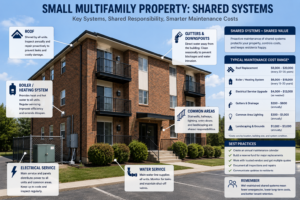
A duplex, triplex, or small multifamily property often shares certain systems, a single roof, sometimes a shared boiler or water heater, common hallways and entryways, across multiple units. That sharing can reduce the per-unit cost of major systems since one roof replacement serves multiple rent rolls instead of just one. It also means a single deferred repair can affect several tenants simultaneously rather than one, which raises the stakes on getting maintenance timing right.
Common-area maintenance introduces its own line item that single-family owners never encounter: shared hallway lighting, entryway upkeep, and exterior grounds that don’t belong to any single unit’s lease but still need attention and budget. This cost gets easy to overlook precisely because it doesn’t show up on any individual tenant’s maintenance request.
A shared roof spreads the cost across more doors, but it also means one bad decision about deferring that repair puts every tenant in the building at risk at the same time.
Where the Hidden Costs Actually Hide
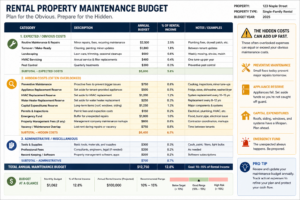
For single-family rentals, the hidden cost is usually underestimating age-related system failure. A roof, HVAC system, or water heater doesn’t announce a fixed expiration date, and owners frequently budget as though a system that’s worked fine for years will keep working fine indefinitely, right up until it doesn’t, usually at the least convenient moment.
For small multifamily properties, the hidden cost is coordination overhead and common-area neglect. Property management companies frequently charge a 5 to 15% markup on maintenance costs, and that markup applies to every repair, shared-system or unit-specific, which means poorly coordinated multifamily maintenance, multiple separate vendor visits instead of batched work, quietly inflates costs beyond what the property’s system count alone would suggest.
Single-Family vs. Small Multifamily: The Real Cost Picture
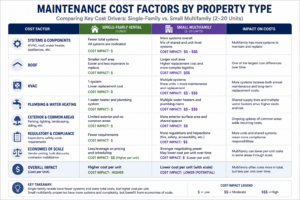
| Factor | Single-Family | Small Multifamily |
|---|---|---|
| Per-unit system cost | Higher, no sharing across units | Lower per unit for shared systems (roof, boiler) |
| Coordination complexity | Lower, one tenant relationship | Higher, multiple tenants and common areas |
| Risk if a repair is deferred | Affects one household | Can affect multiple households at once |
| Common-area maintenance | Not applicable | Additional line item (hallways, grounds, shared lighting) |
| Budget rule of thumb | Roughly 1% of property value annually | Similar percentage, but with shared-system averaging |
| Vendor visit efficiency | One trip per issue | Can batch multiple units’ issues into one trip if coordinated well |
When Each Property Type’s Maintenance Profile Favors You
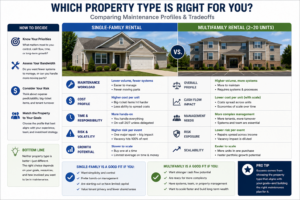
Single-family maintenance economics favor you when:
- You want simplicity, one tenant, one set of systems, no common-area disputes
- You’re comfortable budgeting for full-cost system replacement without cost-sharing across units
- Your portfolio strategy prioritizes fewer, higher-quality properties over unit count
Small multifamily maintenance economics favor you when:
- You can coordinate vendor visits efficiently to capture the batching advantage
- You’re prepared to actively manage common-area upkeep as its own budget line
- You’re comfortable with the higher stakes of a shared-system failure affecting multiple tenants at once
Getting Started: Budgeting Accurately for Your Property Type
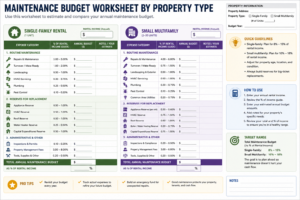
For single-family rentals, budget for full-cost system replacement, not just routine repairs. Set aside a separate capital expenditure reserve beyond the 1% maintenance rule for major systems nearing the end of their lifespan.
For small multifamily properties, add a dedicated common-area line item. This cost is easy to underestimate because it doesn’t map to any single tenant’s request.
Coordinate multifamily vendor visits to capture the batching advantage. Scheduling multiple units’ non-urgent repairs into a single vendor trip reduces the effective cost per repair.
Track age and condition of shared systems closely in multifamily properties. A deferred repair here carries higher stakes than the same deferral in a single-family unit.
Ready to Get an Accurate Maintenance Budget for Your Property?
Whether you own a single-family rental or a small multifamily building, an accurate maintenance budget, built around how that specific property type actually behaves, is worth getting right before the next major system reaches the end of its life.
Frequently Asked Questions
Is a single-family rental or small multifamily property cheaper to maintain?
Neither is universally cheaper. Single-family properties carry higher per-unit costs since every system serves one household, while small multifamily properties can share some system costs across units but add common-area maintenance and coordination complexity.
What’s a reasonable maintenance budget for a single-family rental?
A common rule of thumb is 1% of the property’s value per year, though older housing stock often runs higher due to aging systems. This should be tracked separately from a capital expenditure reserve for major system replacements.
What is common-area maintenance in a small multifamily property?
Common-area maintenance covers shared spaces that don’t belong to any single unit’s lease, like hallway lighting, entryways, and exterior grounds. It’s a distinct budget line that single-family owners never encounter but multifamily owners need to plan for separately.
Does a shared roof on a multifamily property actually save money?
It can reduce the per-unit cost of a major system replacement since one roof serves multiple rent rolls. However, it also means deferring that repair puts every unit in the building at risk simultaneously, raising the stakes on timing the replacement correctly.
How much markup do property managers typically add to maintenance costs?
Property management companies commonly charge a 5 to 15% markup on maintenance costs. This applies across both single-family and multifamily properties, though poorly coordinated multifamily maintenance can compound this cost through inefficient, uncoordinated vendor visits.
Should I budget differently for an older property versus new construction?
Yes. Older housing stock, common throughout Philadelphia and Pittsburgh, typically requires a maintenance budget above the standard 1% rule of thumb due to aging plumbing, electrical systems, and roofing nearing the end of their useful life.
How Rentwell Helps Owners Make This Shift
This is the exact shift Rentwell builds for owners across Philadelphia and Pittsburgh: leasing systems that fill vacancies on a predictable schedule, a maintenance program that catches issues before they get expensive, and owner reporting that answers the question before it gets asked. Owners get their hours back, and they get them back with a clearer picture of how each property is actually performing.
If self-managing is starting to feel like a second job instead of an investment, a second set of eyes on the setup costs nothing.
Rentwell is a full-service property management company serving Philadelphia, Pittsburgh, West Chester, and the surrounding Pennsylvania communities. With offices in Clifton Heights, Pittsburgh, and West Chester, Rentwell helps real estate investors protect their assets, reduce operational stress, and build long-term wealth through professional property management.