
Real estate wealth comes from operations that hold up under growth, not from unit count alone. A portfolio of ten poorly managed properties generates less real return and far more stress than five well-systematized ones. The single most common reason growing portfolios stall isn’t a shortage of good deals, it’s operational infrastructure that was never built to handle the volume it’s now carrying.
Every investor starts somewhere with a mental model that says more doors equals more freedom. More units, more rent collected, more equity building, more passive income. It’s not wrong exactly, but it skips a step. Doors don’t generate freedom on their own. Well-run doors do. Poorly run doors generate exactly the opposite of what most investors are chasing, more calls, more fires, more of your own time consumed by a portfolio that was supposed to be buying that time back.
I’ve watched owners hit this wall around the same point almost every time, somewhere between three and six properties, right when a system built out of a shared inbox and a mental checklist stops being able to keep up. The investors who keep growing past that point aren’t the ones who found better deals. They’re the ones who fixed their operations before adding the next property, not after.
Why More Doors Without Systems Backfires

According to research, landlords managing growing portfolios typically lose the most time to repetitive administrative tasks, not high-level investment decisions. That’s the trap. The work that actually eats an owner’s week isn’t finding the next deal, it’s chasing vendor invoices, updating listing photos, and answering the same category of tenant question for the fifth time that month.
Every additional property without a system to support it adds administrative load faster than it adds passive income. A portfolio that looks great on a spreadsheet, ten doors, strong rent roll, can simultaneously be the reason an owner hasn’t taken a real weekend off in months. The doors aren’t the problem. The absence of a system built to handle them is.
Where Operational Breakdowns Actually Happen
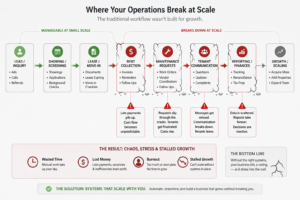
The single most common reason portfolios hit an operational wall is that processes were never written down. Everything works while the workflow lives entirely in the owner’s head, until volume exceeds what memory can reliably track, or the owner is simply unavailable for a stretch and nothing else picks up the slack.
This shows up in specific, predictable ways: a lease renewal date missed because it wasn’t on any calendar but the owner’s own memory, a maintenance request that fell through a crack because there was no formal tracking system, financial records scattered across several accounts that take hours to reconcile at tax time. None of these individually sinks a portfolio. Stacked together across a growing number of units, they define whether growth feels sustainable or like a slow-motion crisis.
A portfolio that depends on you remembering everything isn’t actually generating freedom. It’s generating a job you can never fully clock out of.
Operations-First vs. Doors-First Growth
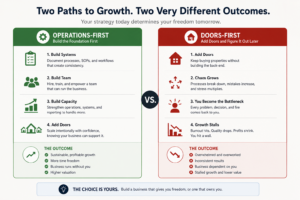
| Approach | What Happens as You Grow | Long-Term Result |
|---|---|---|
| Doors-first (buy first, systematize later) | Administrative load compounds faster than income | Burnout, missed details, plateaued growth |
| Operations-first (systematize, then buy) | Each new property adds to a working system | Sustainable growth, more actual free time |
The difference isn’t about which investor is more ambitious. It’s about which one is building something that can actually carry the weight of what they’re trying to build.
What “Operations” Actually Means in Practice
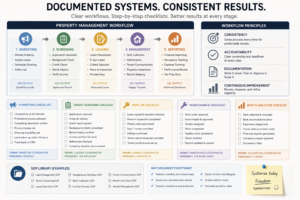
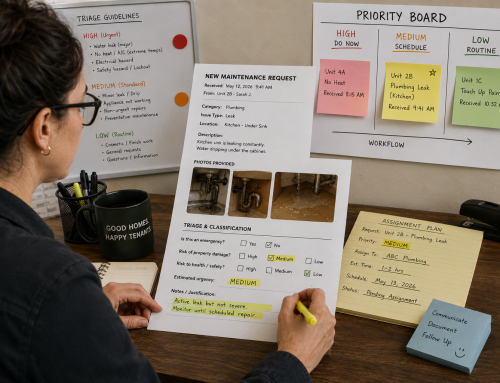
Operations isn’t a buzzword for “getting organized” in a vague sense. It means specific, repeatable systems: a documented process for tenant screening applied the same way every time, a maintenance tracking system that doesn’t depend on anyone’s memory, financial reporting that reconciles automatically instead of requiring hours of manual work each month, and clear delegation, whether to a property manager, a virtual assistant, or defined internal roles, for the tasks that don’t require the owner’s personal judgment.
According to research, professional investors implement online rent collection, real-time financial tracking, delegated management structures, and defined operating procedures specifically because you cannot evaluate performance quickly, or safely add the next property, without them. Profit in this business is frequently made in management, not appreciation, and management quality is entirely a function of the systems behind it.
When to Systematize Before You Buy vs. When You Can Grow Now
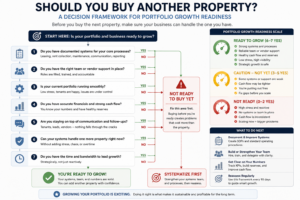
Fix operations before adding the next property when:
- You’re already missing details, renewal dates, maintenance follow-ups, on your current portfolio
- You can’t quickly answer how each property in your portfolio is actually performing without digging
- Adding a property feels like it would require finding more hours you don’t currently have
You’re likely ready to grow now when:
- Your current properties run on documented, repeatable processes, not memory
- You can pull accurate performance data on any property in minutes, not hours
- Your current workload has real margin, not just the appearance of it
Getting Started: Building Operations That Scale With You
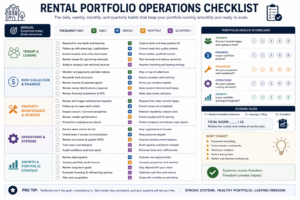
Write down your current processes, even the informal ones. If a workflow only exists in your head, it can’t scale, and it can’t survive you being unavailable for a week.
Centralize financial tracking before you add another property. Manual reconciliation that’s manageable at two properties becomes a real time cost at five or more.
Decide what you’ll delegate before you need to. Waiting until you’re overwhelmed to figure out what to hand off means making that decision under the worst possible conditions.
Measure operational health, not just unit count, as your growth metric. A portfolio running smoothly at five doors is a better foundation than one straining at eight.
Ready to Build Operations That Can Actually Carry Your Growth?
If your portfolio’s next chapter depends on systems that don’t currently exist, that gap is worth closing before the next property, not after.
Frequently Asked Questions
Why do rental property portfolios stall even when the owner keeps buying?
Growth typically stalls because operational infrastructure, tracking, delegation, financial systems, wasn’t built to handle increasing volume, not because of a shortage of good deals. Administrative load compounds faster than income when systems don’t scale alongside the portfolio.
At what portfolio size do most landlords need real systems in place?
Many owners hit an operational wall somewhere between three and six properties, the point where a system built on memory and a shared inbox stops keeping up with the volume of tenant communication, maintenance tracking, and financial reporting required.
Does hiring a property manager count as “operations“?
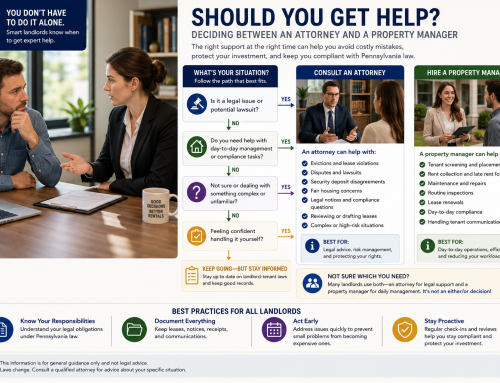
Yes, professional management is one form of delegated operational infrastructure. Whether the systems live with an in-house team, a property manager, or a combination, what matters is that the process is documented and doesn’t depend entirely on one person’s memory.
Is it better to buy another property or fix my current operations first?
If you’re already missing details on your current portfolio, renewal dates, maintenance follow-ups, or performance data, that’s a signal to fix operations before adding volume. A property added to a strained system usually makes the strain worse, not better.
What’s the difference between operations-first and doors-first growth?
Doors-first growth prioritizes acquiring properties and figuring out systems later, which often leads to administrative overload and burnout. Operations-first growth builds repeatable systems before or alongside acquisition, so each new property adds to a working structure rather than straining an already-stretched one.
How do I know if my rental portfolio’s operations are actually working?
A working system lets you pull accurate performance data on any property within minutes, track maintenance and lease renewals without relying on memory, and add a new property without feeling like you need to find more hours you don’t have.
How Rentwell Helps Owners Make This Shift
This is the exact shift Rentwell builds for owners across Philadelphia and Pittsburgh: leasing systems that fill vacancies on a predictable schedule, a maintenance program that catches issues before they get expensive, and owner reporting that answers the question before it gets asked. Owners get their hours back, and they get them back with a clearer picture of how each property is actually performing.
If self-managing is starting to feel like a second job instead of an investment, a second set of eyes on the setup costs nothing.
Rentwell is a full-service property management company serving Philadelphia, Pittsburgh, West Chester, and the surrounding Pennsylvania communities. With offices in Clifton Heights, Pittsburgh, and West Chester, Rentwell helps real estate investors protect their assets, reduce operational stress, and build long-term wealth through professional property management.