Renting your home instead of selling makes the most financial sense when you hold a low mortgage rate you’d give up by moving, when the rental income would cover carrying costs with room to spare, and when you’re not relying on the sale proceeds to fund your next purchase. According to Zillow data, roughly 2.1% of would-be home sellers converted to rentals rather than selling in a recent reading, a rate that rises in softer sales markets.
Watching your home sit on the market longer than expected, or getting offers below what you were hoping for, forces a question a lot of Pennsylvania homeowners never expected to ask: is renting this out actually a better move than selling it for less than I wanted? It’s not a consolation prize question. For a meaningful number of owners, the answer is genuinely yes, and not just as a stopgap.
The decision isn’t really about whether your home could be rented. Almost any home can be. It’s about whether the math, mortgage rate preserved, rental income against carrying costs, your own tolerance for landlord responsibilities, actually favors renting over the clean exit a sale provides. That math is different for every owner, but the questions that determine it are consistent.
The Mortgage Rate Math That’s Driving This Decision Nationally
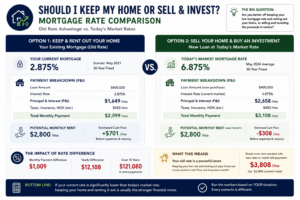
A huge share of the recent rise in accidental landlords traces back to one specific number: the gap between an existing low mortgage rate and current market rates. According to research, roughly 2.1% of would-be sellers gave up on selling and rented their homes out instead in a recent month, with the rate climbing in high-supply markets facing the same buyer hesitancy Philadelphia and Pittsburgh have seen.
If moving means trading a 3% mortgage for something in the sixes or sevens, the math on selling gets a lot harder to justify even at a decent sale price. Holding the property as a rental, letting a tenant’s payment cover the existing low-rate mortgage, preserves that financing advantage while buying time for either the sales market to improve or your own plans to become clearer.
Running the Real Numbers Before You Decide
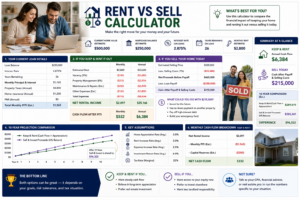
A realistic model accounts for mortgage payoff, home appreciation, rental income, selling costs (typically 6-8%), capital gains tax, rent increases, and the opportunity cost of the capital that would otherwise be freed up by a sale, budgeting vacancy at 5 to 10% and maintenance at 1 to 2% of home value annually rather than assuming a clean, uninterrupted rental income stream.
One tax detail worth flagging specifically: homeowners generally have a limited window, often cited as up to three years after moving out, to sell and still claim the primary residence capital gains exclusion. Hold the property as a rental past that window, and future gains on sale become fully taxable as investment property, a meaningful cost that should factor into the decision if selling later remains a real possibility.
Renting your home instead of selling it isn’t a decision you make once. It’s a decision worth re-running every year, because the mortgage rate gap, the sales market, and your own plans all keep moving.
When Renting Genuinely Makes Sense vs. When Selling Still Wins
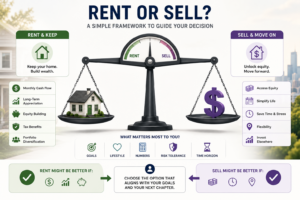
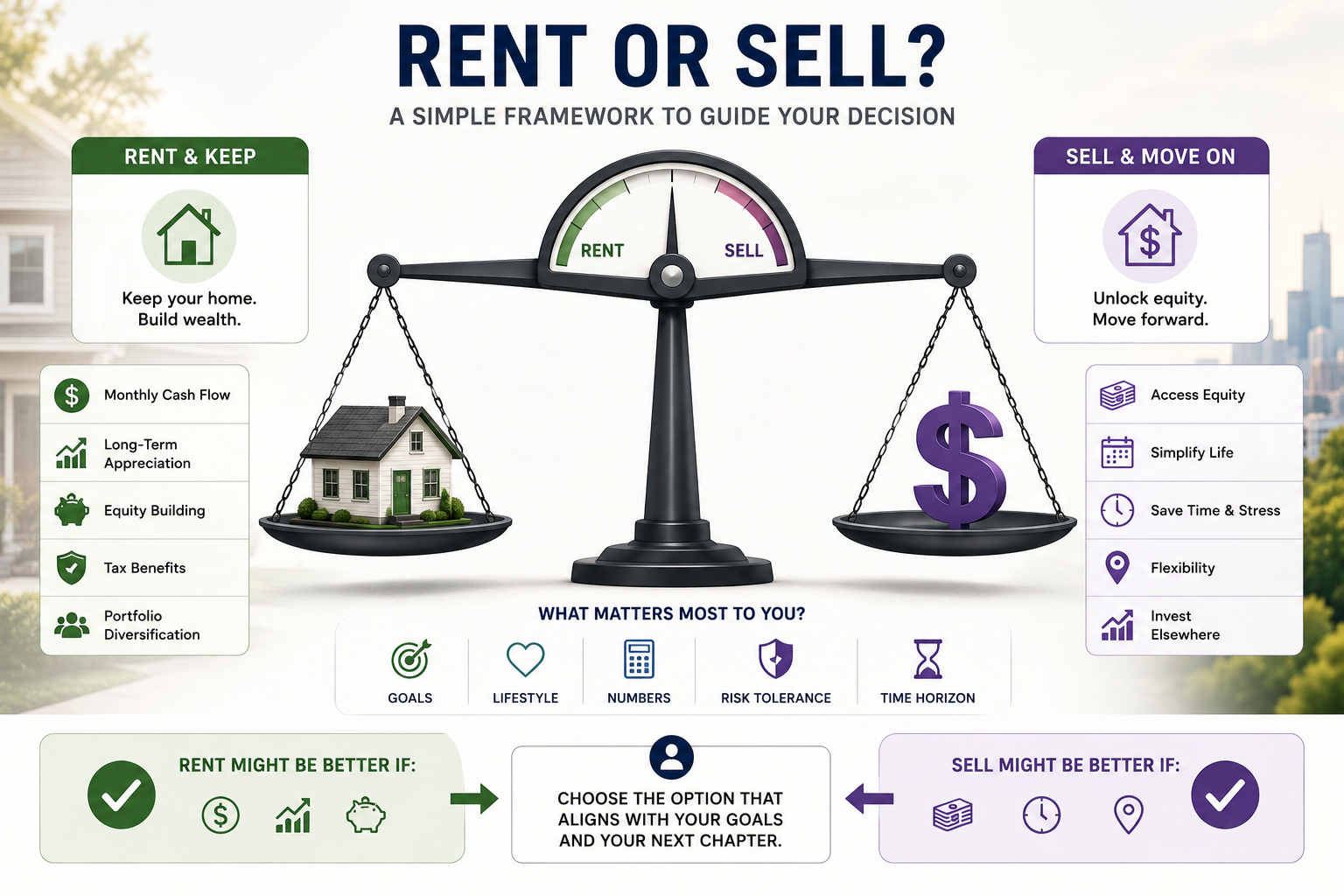
Renting tends to make sense when:
- You’re holding a mortgage rate meaningfully below current market rates
- The rental income would cover the mortgage, taxes, insurance, and a maintenance reserve with room left over
- You’re not dependent on the sale proceeds for your next move, whether that’s a down payment or another financial goal
Selling still tends to win when:
- You need the equity now, for a down payment, debt payoff, or another immediate use
- The rental income wouldn’t come close to covering carrying costs even with conservative vacancy and maintenance assumptions
- You have no real interest in landlord responsibilities, even with professional management handling the day-to-day
Neither answer is permanent. Plenty of owners rent for a year or two as a bridge strategy, holding the option to sell open once the market shifts or their own plans firm up.
Getting Started: Evaluating Your Specific Situation
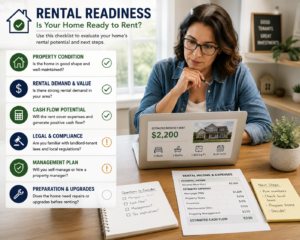
Get a real rental estimate, not a guess. A professional rental analysis, based on comparable local rentals, tells you what the home would actually lease for, which is the foundation every other number depends on.
Compare your actual mortgage rate to current market rates. The size of that gap is often the single biggest factor in whether renting makes financial sense.
Model vacancy and maintenance conservatively, not optimistically. Budget 5 to 10% vacancy and 1 to 2% of home value for annual maintenance rather than assuming a best-case scenario.
Know your capital gains exclusion timeline before you decide. If selling later remains a real possibility, understand how long you have before that option gets more expensive.
Ready to Run Your Actual Numbers?
If you’re weighing whether to rent your home instead of selling it, running the real numbers, rental estimate, carrying costs, and tax timeline together, is worth doing before the decision gets made by default.
Frequently Asked Questions
Is it better to rent out my home or sell it if I can’t get the price I want?
It depends on your mortgage rate relative to current market rates, whether rental income would cover your carrying costs, and whether you need the sale proceeds now. Many owners find renting makes sense as at least a temporary bridge strategy when selling at a lower-than-expected price is the only alternative.
How many homeowners are converting their homes to rentals instead of selling?
National Zillow data has shown roughly 2.1% of would-be sellers converting to rentals in a recent reading, a rate that rises in high-supply markets where buyers are hesitant and sale prices are softer than sellers expect.
Will I lose my capital gains tax exclusion if I rent out my former primary residence?
You generally have a limited window, often cited as up to three years after moving out, to sell and still claim the primary residence capital gains exclusion. Holding the property as a rental past that window typically makes future gains fully taxable as investment property.
What expenses should I budget for if I rent out my home instead of selling?
Beyond the mortgage, budget for vacancy (typically 5-10% of annual rent), maintenance (1-2% of home value annually), property taxes, insurance, and property management if you’re not self-managing. Modeling these conservatively avoids an unpleasant surprise after the decision is made.
Can I go back to selling later if I rent my home out first?
Yes, renting doesn’t have to be permanent. Many owners use it as a bridge strategy, holding the property as a rental for a year or more while waiting for the sales market to improve or their own plans to become clearer, then reassessing.
Do I need property management if I rent out my home for the first time?
It’s not required, but first-time landlords, especially those who’ve never managed a rental before, often benefit from professional management to handle screening, maintenance, and compliance correctly from the start, particularly if they’re not planning to be a long-term hands-on landlord.
How Rentwell Helps Owners Make This Shift
This is the exact shift Rentwell builds for owners across Philadelphia and Pittsburgh: leasing systems that fill vacancies on a predictable schedule, a maintenance program that catches issues before they get expensive, and owner reporting that answers the question before it gets asked. Owners get their hours back, and they get them back with a clearer picture of how each property is actually performing.
If self-managing is starting to feel like a second job instead of an investment, a second set of eyes on the setup costs nothing.
Rentwell is a full-service property management company serving Philadelphia, Pittsburgh, West Chester, and the surrounding Pennsylvania communities. With offices in Clifton Heights, Pittsburgh, and West Chester, Rentwell helps real estate investors protect their assets, reduce operational stress, and build long-term wealth through professional property management.