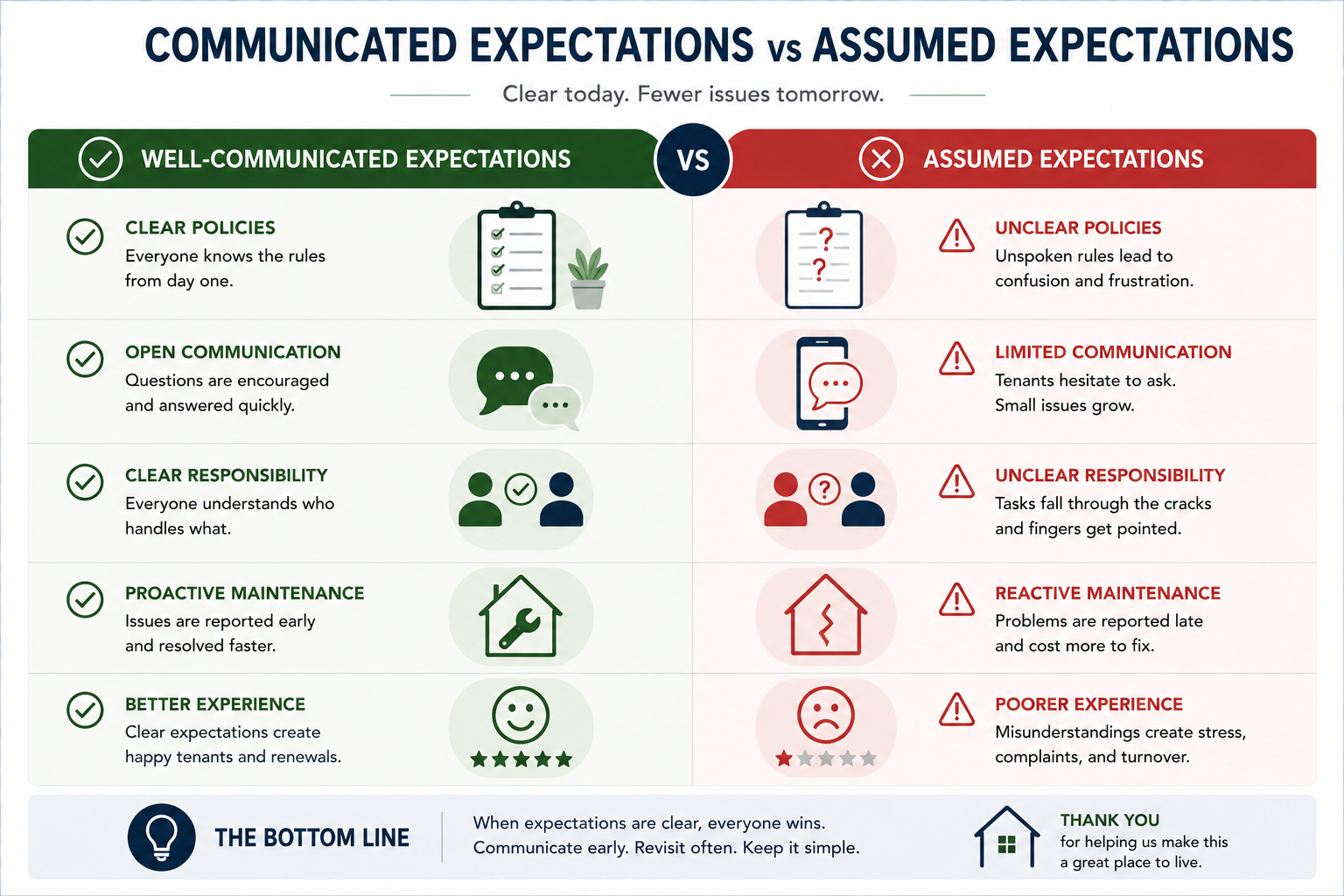
Most landlord-tenant conflict doesn’t come from bad intentions on either side, it comes from something that was never clearly communicated at the start. Setting expectations at move-in means covering rent logistics, maintenance responsibilities and response times, communication channels, and property care standards in writing, not just verbally, so neither party is left guessing later.
Nearly every landlord-tenant dispute that ends up feeling personal started as something much smaller: an assumption one side made that the other side never actually agreed to. The tenant assumed maintenance requests got same-day attention. The landlord assumed the tenant knew quiet hours applied to guests too. Neither assumption was unreasonable. Neither was ever actually stated.
Move-in is the moment to close that gap, before either side has formed an assumption that later turns into a grievance. Getting this right isn’t about being rigid or overly formal. It’s about making sure nothing important is left to guesswork.
Rent Logistics: More Detail Than Feels Necessary
Due date, accepted payment methods, late fee policy and grace period if any, and what happens if a payment fails, all of this should be explicit, not assumed to be obvious. According to research, detailed lease ensures both parties understand their roles and responsibilities from day one, and financial terms are exactly where ambiguity causes the most friction.
Even something as simple as “rent is due on the 1st” benefits from more specificity: is there a grace period, does a weekend or holiday due date shift the deadline, what’s the exact late fee amount and when does it apply. Spelling this out removes the awkward first conversation that otherwise happens the first time a payment is even a day late.
Maintenance: Who Does What, and How Fast
According to research, maintenance delays are among the most common sources of tenant complaints, and setting clear response timelines, such as 24 to 48 hours for non-urgent issues, in writing at the start significantly reduces frustration even when a repair genuinely takes a few days.
Cover how requests should be submitted, what response time to expect for different urgency levels, what counts as an emergency versus something that can wait, and which small maintenance tasks, if any, are the tenant’s responsibility, like replacing light bulbs or HVAC filters. A tenant who knows a routine request typically gets addressed within 48 hours isn’t surprised or frustrated when it isn’t fixed the same day. A tenant who was never told anything has no baseline, so any wait feels arbitrary.
Communication: Channels and Realistic Response Times
Tell new tenants exactly how to reach you or your property manager, and roughly how quickly they should expect a response for different types of issues. Communication and anticipating common areas of confusion is a strategic foundation for stable tenancy, not just a courtesy.
This also means being upfront about what channels aren’t monitored closely. If texts to a personal cell phone don’t get the same response priority as a formal maintenance portal submission, say so clearly at move-in. Otherwise a tenant reasonably assumes every channel works the same way, and finds out otherwise only after something urgent went unanswered.
A tenant who knows what to expect and gets exactly that rarely files a complaint. A tenant who didn’t know what to expect files a complaint about almost anything that falls short of an assumption they never should have had to make.
Property Care and House Rules: Say the Obvious Things Anyway
Quiet hours, guest policies, parking rules, pet policies, and any shared-space etiquette should all be stated explicitly, even when they feel like common sense. Setting clear expectations for tenants is one of the most effective ways to curtail misbehavior and reduce disputes between neighbors sharing a building.
The move-in inspection is also the natural moment to draw a clear line between normal wear and tear, which shouldn’t affect a security deposit, and actual damage, which might. Stating that distinction upfront, rather than only explaining it for the first time during a move-out dispute, sets a shared standard both sides can reference later.
What Gets Communicated vs. What Gets Left to Assumption
| Topic | Should Be Explicit | Commonly Left as an Assumption |
| Rent due date and grace period | Exact date, weekend/holiday handling, late fee amount | “Rent is due on the 1st” with no further detail |
| Maintenance response time | Specific windows by urgency tier | “We’ll get to it” with no timeframe |
| Communication channels | Which channel for which type of issue | Assuming every channel gets equal priority |
| Emergency definition | Specific examples of what qualifies | Left undefined until a real situation tests it |
| Normal wear vs. damage | Explained at move-in with the inspection as reference | Only clarified for the first time at move-out |
When Written Documentation Is Enough vs. When a Verbal Walkthrough Adds Real Value
A written welcome packet alone is often enough when:
- The tenant has rented before and is generally familiar with standard lease terms
- The property doesn’t have unusual rules or shared-space complications
- The lease itself is already detailed and the tenant has had time to read it
A verbal walkthrough adds real value when:
- It’s the tenant’s first time renting, and unfamiliar terms benefit from a live explanation
- The property has shared spaces or specific quirks worth walking through in person
- You want to build rapport early, which written documents alone can’t fully accomplish
Getting Started: Building Your Own Move-In Communication Standard
Build a written welcome packet covering rent, maintenance, communication, and house rules. This becomes your consistent standard applied to every new tenant, not something recreated from memory each time.
State response time windows specifically, not vaguely. “24-48 hours for non-urgent requests” sets a real expectation. “We’ll get to it soon” sets none.
Use the move-in inspection to explain wear and tear versus damage. This single conversation, had early, prevents most move-out disputes before they start.
Follow up in writing after any verbal conversation. A quick confirmation email after a walkthrough protects both sides if a question comes up later about what was actually discussed.
Ready to Onboard Every New Tenant the Same, Consistent Way?
A clear, documented move-in process protects the tenant relationship from day one and reduces the disputes that cost time and trust later.
Frequently Asked Questions
What should landlords communicate to tenants at move-in?
Rent payment logistics, maintenance responsibilities and expected response times, communication channels, house rules, and the distinction between normal wear and tear and actual damage. Covering these explicitly, in writing, prevents most of the misunderstandings that later turn into disputes.
Why do most landlord-tenant conflicts happen even when both sides act reasonably?
Most conflicts trace back to something that was never clearly communicated rather than bad intentions on either side. A tenant and landlord can both act reasonably based on different unstated assumptions and still end up in a dispute neither intended.
Should tenant expectations be communicated verbally or in writing?
Both work best together. A written welcome packet creates a consistent, referenceable standard, while a verbal walkthrough, especially for first-time renters, helps ensure the information is actually understood rather than just provided.
What maintenance response time should I promise new tenants?
Many landlords set 24 to 48 hours for non-urgent issues and same-day or immediate response for true emergencies. Setting a specific window, rather than a vague promise, reduces tenant frustration even when a repair takes the full window to resolve.
How does explaining normal wear and tear at move-in help later?
Explaining the distinction at move-in, ideally during the move-in inspection, gives both parties a shared reference point. This significantly reduces disagreements at move-out about whether specific damage should affect the security deposit.
Does setting clear expectations actually improve tenant retention?
Yes. Clear communication builds trust and predictability, which multiple industry sources link to improved tenant satisfaction and lower turnover, since tenants who know what to expect are less likely to feel blindsided or frustrated during their tenancy.
How Rentwell Helps Owners Make This Shift
This is the exact shift Rentwell builds for owners across Philadelphia and Pittsburgh: leasing systems that fill vacancies on a predictable schedule, a maintenance program that catches issues before they get expensive, and owner reporting that answers the question before it gets asked. Owners get their hours back, and they get them back with a clearer picture of how each property is actually performing.
If self-managing is starting to feel like a second job instead of an investment, a second set of eyes on the setup costs nothing.
Rentwell is a full-service property management company serving Philadelphia, Pittsburgh, West Chester, and the surrounding Pennsylvania communities. With offices in Clifton Heights, Pittsburgh, and West Chester, Rentwell helps real estate investors protect their assets, reduce operational stress, and build long-term wealth through professional property management.