
Effective tenant screening weighs verified income (2.5 to 3 times monthly rent), a credit score generally in the 620 to 650 range as a baseline rather than a hard cutoff, and direct rental history from actual previous landlords, applied the same way to every applicant. A single low credit score or thin credit file matters less than a documented pattern of late payments or a recent eviction.
Most landlords screen for the wrong thing first. They pull the credit report, see a number, and make a snap judgment before ever calling a previous landlord who could tell them whether this person actually pays rent on time and takes care of a property. The credit score is useful. It’s just not the most useful thing in the file, and treating it like the deciding factor is how good tenants get rejected and risky ones get approved.
Philadelphia’s rental market adds its own layer to this. Older housing stock, a wide range of neighborhoods with very different tenant pools, and Pennsylvania’s fair housing requirements all mean a screening process copied from a national template often misses the details that matter locally. Here’s what actually predicts whether a tenant will work out, and what’s overweighted in most owners’ minds,
Income Verification Matters More Than the Score Itself

The standard benchmark is gross monthly income equal to 2.5 to 3 times the rent, verified with pay stubs, tax returns, or bank statements, not just a number the applicant writes on a form.
Industry trend reports consistently point to this 2.5 to 3x range as the standard for predicting a tenant’s ability to sustain rent payments over a full lease term.
What matters here isn’t just the total income, it’s the source stability. A single stable paycheck that clears the 3x threshold is a stronger signal than a combination of gig income sources that technically add up but carry more variability month to month. Pennsylvania law requires evaluating the sufficiency of income, not discriminating based on its source, so a housing voucher or Social Security income counts the same as W-2 wages toward the threshold.
Credit Score Is a Baseline, Not a Verdict
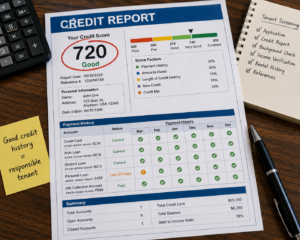
Most landlords set a minimum credit score somewhere in the 620 to 650 range, but the number alone tells an incomplete story. A 640 driven by medical debt or a single collections account from years ago reads very differently than a 640 with a pattern of missed rent and revolving credit maxed out right now.
The smarter approach looks at the full credit history alongside the score: recent payment patterns, the age and type of any negative marks, and whether the debt-to-income ratio suggests the applicant can realistically absorb rent on top of existing obligations. A rigid cutoff that rejects every application under a fixed number, without looking deeper, isn’t more rigorous screening. It’s just a shortcut that misses context.
Rental History Beats Almost Everything Else

If you only have time to do one thing well, do this one. Contact at least two previous landlords, and specifically skip the current one, since a landlord actively trying to get rid of a problem tenant has an incentive to give a glowing reference just to move them along. Ask direct questions: Did they pay on time? Did they take care of the unit? Would you rent to them again?
No single factor should determine the outcome on its own, but patterns across income, credit, and rental history together tell you far more than any one data point in isolation. A tenant who’s stayed in their last residence for 12 or more months, with a landlord who confirms consistent on-time payment, is showing you exactly the kind of stability that a credit score alone can’t fully capture.
A credit score tells you what happened. A previous landlord tells you what it was actually like to rent to this person, which is the question you’re really trying to answer.
Consistency Is the Legal Requirement Owners Forget

Whatever standard you set, credit minimum, income ratio, rental history requirement, it has to apply to every applicant, every time, documented the same way. Applying a stricter standard to one applicant than another isn’t just inconsistent, it’s a fair housing risk, particularly if the inconsistency correlates with a protected class even unintentionally.
This is where a lot of self-managing landlords get exposed without realizing it. Screening “by feel,” where one application gets a closer look because something felt off and another gets waved through because the landlord liked the applicant, creates exactly the kind of pattern that turns into a discrimination complaint. Written, documented criteria applied uniformly protects both the landlord and the applicant.
What Actually Matters vs. What Gets Overweighted
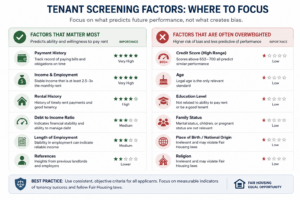
| Screening Factor | What It Actually Tells You | Common Mistake |
|---|---|---|
| Verified income (2.5-3x rent) | Ability to sustain rent over the lease term | Accepting stated income without verification |
| Credit score | A baseline risk indicator, not a full picture | Using a hard cutoff with no context review |
| Previous landlord reference | Real-world payment and property care history | Skipping it or only calling the current landlord |
| Length of previous tenancy | Stability and likelihood of renewal | Overlooking it in favor of the credit number alone |
| Criminal background | Requires individualized review under fair housing guidance | Blanket denial policies based on any record |
| Application completeness | Whether the applicant is organized and responsive | Rushing to fill vacancy with an incomplete file |
When to Dig Deeper vs. When a Standard Review Is Enough
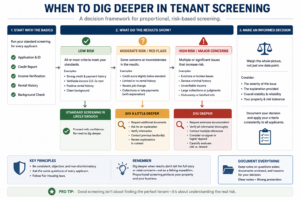
Dig deeper when:
- Income sources are varied or harder to verify, like multiple gig platforms or self-employment
- Credit history shows a recent pattern rather than an old, resolved issue
- A previous landlord reference is vague or unreachable after reasonable attempts
A standard review is enough when:
- Income is verified through consistent W-2 pay stubs well above the 3x threshold
- Credit history shows a clean or explainable pattern with no recent red flags
- At least one previous landlord confirms on-time payment and good property care
The goal isn’t to make every application an investigation. It’s knowing which ones warrant a closer look before you commit to a year-long lease.
Getting Started: Building a Screening Process That Holds Up

Write your criteria down before you list the property. Minimum income ratio, credit baseline, and rental history requirements, documented in advance, protect you from inconsistent, case-by-case decisions later.
Verify income with documents, not statements. Pay stubs, tax returns, or bank statements confirm what an applicant tells you rather than taking their word for it.
Call actual previous landlords, not just references the applicant chose. This single step catches more real risk than any other part of the process.
Apply the same standard to every applicant, and document that you did. Consistency is both good screening practice and your best protection against a fair housing complaint.
Ready to Build a Screening Process You Can Trust?
If you want your screening handled consistently, verified properly, and documented the way fair housing law requires, that’s exactly the kind of system professional management is built around.
Frequently Asked Questions
What credit score do I need to require for tenants in Philadelphia?
Most landlords set a minimum in the 620 to 650 range as a baseline, not an automatic cutoff. The full credit history, including the age and pattern of any negative marks, matters more than the number alone.
How much income should a tenant have relative to rent?
The standard benchmark is gross monthly income equal to 2.5 to 3 times the monthly rent, verified through pay stubs, tax returns, or bank statements rather than a self-reported figure.
Why should I call a previous landlord instead of just checking credit and income?
A previous landlord can confirm whether a tenant actually paid on time and took care of the property, information a credit report and income verification can’t fully capture. Always contact a landlord prior to the current one, since a current landlord may have an incentive to give a favorable reference to move a problem tenant along.
Can I reject an applicant with a criminal record automatically?
No. HUD guidance discourages blanket denial policies based on any criminal record. An individualized review considering the nature, severity, and age of the offense is the legally sound approach, and denials should be documented with clear reasoning.
Is it legal to reject a tenant for using a housing voucher in Pennsylvania?
Screening criteria should evaluate the sufficiency of income regardless of its source. Rejecting an applicant solely because their income includes a housing voucher or other lawful source, rather than because it fails to meet your income threshold, creates fair housing risk.
How do I stay consistent across all my tenant applications?
Write your screening criteria down before listing the property, apply the exact same standard to every applicant, and document each decision the same way. This protects you legally and produces better tenant outcomes than case-by-case judgment calls.
How Rentwell Helps Owners Make This Shift
This is the exact shift Rentwell builds for owners across Philadelphia and Pittsburgh: leasing systems that fill vacancies on a predictable schedule, a maintenance program that catches issues before they get expensive, and owner reporting that answers the question before it gets asked. Owners get their hours back, and they get them back with a clearer picture of how each property is actually performing.
If self-managing is starting to feel like a second job instead of an investment, a second set of eyes on the setup costs nothing.
Rentwell is a full-service property management company serving Philadelphia, Pittsburgh, West Chester, and the surrounding Pennsylvania communities. With offices in Clifton Heights, Pittsburgh, and West Chester, Rentwell helps real estate investors protect their assets, reduce operational stress, and build long-term wealth through professional property management.